Category Archives: Movie Review

Movie Review: Splice

Some movies are too weird for their own good. Other movies find ways to be good through all the weirdness. “Splice” balances on the line between these two.

“Splice” is the latest film from Vincenzo Natali. Natali has the name of a great horror director, and he could just become one. I have never seen any of his previous works, but “Splice” shows that he knows this genre, and the several other ones that the film navigates.
“Splice” is infatuated with low angle, and usually subjective, shots. One of the best choices it makes is opening through the blurry, confused eyes of a newborn. This is no newborn, this is the birth of a new species. This is a creation from scientists (and lovers) Clive (Adrien Brody) and Elsa (Sarah Polley). The two figured out how to isolate the DNA of various types of animals and morph them into one, new species. The new species is active, healthy, and can even produce medicinal milk. It turns out to be both a scientific and economic wonder.
Clive and Elsa want to take their experiment to the next level: they want to add human DNA. However, the company isn’t looking for scientific breakthroughs, but rather profit, and forces them to continue research on the milk the new creature produces. They go ahead with their experiment anyway. The result is a creature with the face of a human, the body of a small kangaroo, and the skin of a salamander. The clone, named Dren, starts off sweet and innocent enough. Then she turns, quite literally, into a monster.
The film is proceeded by some noteworthy shots, a few corny lines, and a few great thrills. It is a mixture of scientific intrigue and fictional ridiculousness. Despite some flaws, “Splice” is still miles ahead of most sci-fi films released in recent years. It draws upon, rather than steals from, classics.
On that note, the thing I enjoyed most about “Splice” is how inspired it was. Natali is a film lover’s filmmaker. The slow, creeping doom that occurs alongside the speedy development of the creature feels right out of “Alien.” A later scene involves a chase through a dark, snowy, forest reminiscent to the frozen maze chase that occurs in “The Shining.” At one point, a character even shouts “It’s alive!” just like Rosemary mistakenly shouted in joy in “Rosemary’s Baby.” It might just sound like I’m merely throwing out every film reference I can to look cool, but I’m actually throwing out compliments. Natali doesn’t just know great films, but he knows what makes them so great. And those things influence his work in the best way.
Don’t get the impression from this that Natali’s work is nothing but a lot of pop culture reference. He is also a great director for individual reasons. The sci-fi works great because he understands how the sci-fi genre operates. The horror aspects work especially well because he understands how to create real thrills. As usual, it is not about the gore. What is crucial is atmosphere. He can create a moment of suspense either threw loud, overbearing music, or pure silence. One of the most impressive ways that he creates an environment of dread is through very tiny details. The most significant is a light swaying back and forth overhead, as the couple waits to see if there creation has survived.
“Splice” also displays some impressive cinematography. It contributes to the atmosphere as much as the sound and music. Best of all, it doesn’t rely on an unnecessary large amount of shaky cam to try and frighten the viewer. Any horror you might feel comes organically.
As I am not Natali, I can’t say what his true goal was with “Splice.” If it was simply to thrill us and weird us out, then mission accomplished. But if he was looking for something even deeper, which I suspect he was, then he just missed the mark.
At times, I thought “Splice” was going for the “Brave New World” message that there’s a line in science, and sometimes we just shouldn’t toy too much with our own DNA. Then there’s also this whole thing about how science is being ruined by corporate greed. These are themes that have been explored again and again, and I wish “Splice” did it in a slightly more original, and even more three-dimensional way.
The reason these two things don’t work so well might just be because of the weakest aspect of the film: the writing. All of the arguments about the place of science and moral judgement just sound contrived. Such eloquent directing could’ve used much more eloquent writing.
While I obviously appreciated this film as a thriller, I wish Natali had gone and made it a little more satirical. There is one moment in the film (you’ll know it when you see it), that’s so gruesome and unexpected that it ends up being uncomfortably hilarious. Some might find it horrifying, others might find it to be the most genius moment in the entire film.
“Splice” certainly isn’t your average sci-fi horror film, as Natali certainly isn’t your average director. And even though the film falters on several points, it’s hard not to recommend “Splice.” After having to sit through “Robin Hood” and endless “Sex and the City 2″ ads, any actual story is welcome.

Movie Review: La Dolce Vita

When one thinks of the most iconic images in cinema, what comes to mind might be an odd extra terrestrial flying over the moon in a bicycle. Or Humphrey Bogart giving up the one thing he loves on a misty tarmac. Or Janet Leigh meeting a particularly grisly end while taking a shower.

Though few ever seem to bring up the image of Anita Eckberg, in a long black dress, seductively waltzing through the waters of Trevi Fountain. It is not just the image itself that is so awe-inspiring, but rather the culmination of sounds, feelings, and events leading up to this very moment. For a director I once found to be cold and somewhat overly obsessed with his own work, Federico Fellini takes much of the same things I once found cold and smug and turns them into true emotion and beauty in “La Dolce Vita.”
“La Dolce Vita” is about both everything and nothing at the same time. In a close to three hour running time, it accomplishes so little, yet every second feels earned.
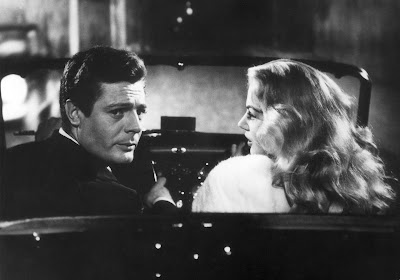
While plot isn’t the film’s number one concern, there certainly is one. Marcello (Marcello Mastroianni) is a gossip writer who drives a tiny convertible on his constant life on the road. While he seems content with his on-the-go lifestyle, he often longs for a day when he can settle down. Yet, he is discontent with his suicidal but caring lover, Emma (Yvonne Furneaux). So, he embarks on affairs with the beautiful Maddelena (Anouk Aimee) and the free spirited Swedish-American actress Sylvia (Ekberg). It is during his affair with Sylvia that he goes from a chaotic life of his own rules, to a total indulgence in, well, the sweet life.
Before this, the only other Fellini film I had viewed was “8 1/2.” That film is usually considered Fellini’s masterpiece. It was mesmerizing for around 90 minutes, and then it just went nowhere fast. “La Dolce Vita” is very similar to “8 1/2″ in that it contains a wandering narrative. Yet, this narrative seems more grounded in reality, and makes an even more interesting point about life.
Fellini’s point seems to be capturing life itself. There are so many strange yet fascinating rituals and events captured. Besides the waltz in Trevi Fountain, there are other great sights such as the pilgrimage to the site of the Virgin Mary and the circus acts that take place inside a lively nightclub. Random occurrences like these are not sidesteps away from the actual story, but rather things that make the story even better.
There are moments in “La Dolce Vita” where everything is glaringly self-aware. It knows that in the end, it is a film. It doesn’t do this through winks, but merely by experiencing what is on screen. It might make you jitter a little bit to see an Italian Neorealist film that mentions Neorealism in it, or to see the giant lights set up from a film crew, probably facing the actual crew of the film.
Fellini is one of those directors that’s so great simply because he understands how to work a camera and put a film together. He knows how one little object, or one little beat, can have a ripple effect and change the entire course of a film. Once again, take a look at the Trevi Fountain scene. It is not just the visual that you won’t forget, but the those soft plucks of the harp. It all amounts to an underlying beauty and perfection. The power of the gods flows through the waters and transforms Sylvia into a goddess figure with a hypnotic nature.
The title “La Dolce Vita” carries both bitter ironies and bitter truths. Marcello lives both everyone’s dream, and everyone’s nightmare. He feels he can do whatever he pleases, because he has no one to tell him otherwise. It is not so much traveling he is addicted to but isolation. That’s what makes his story all the more haunting.
The rest of the characters are as fascinating as the locations. The rest of the cast is constantly changing, yet each is presented well enough that their quirks and personalities are fully understood. Each one seem to become a part of Marcello’s collective consciousness. Throughout the film, many comment that he has no heart. He is more like a blank slate, collecting ideas and pieces of personality through all of the people he encounters.
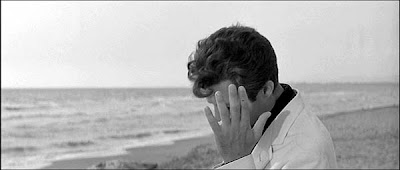
I don’t want to give away the ending of the film, only briefly discuss it. Though I wouldn’t be giving away the end of a story, but the end of a character development. Let’s just say it ends at an odd moment, one that feels a little like “The Old Man and the Sea.” The rest of the conclusion is told through gusts of wind and crashing waves. Like Hemingway, Fellini can tell a story and bring to the surface all of his themes through a few simple, yet extremely meaningful images. The emotions that are never stated, yet are so palpable, in the conclusion will not leave you once the credits roll.
“La Dolce Vita” is not just a film lover’s film, but film in its purest form. Through the lavish dance numbers, parties, and debauchery, a point emerges. Fellini seems less interested in capturing a story than he is in capturing the beauty of the moving image.

Movie Review: Get Him to the Greek

Hollywood loves sequels. They love it. They’re a little too in love though. If Hollywood wants to continue banking off of franchise-worthy films, they should consider spin-offs over sequels. “Get Him to the Greek” shows that perhaps individual characters, and not entire plots, were meant to be seen again.

“Get Him to the Greek” uses the 2008 instant classic “Forgetting Sarah Marshall” as its starting point. It pulls away Aldous Snow (Russell Brand), the self-absorbed English rocker. Snow still exists in the same universe as “Sarah Marshall.” After the success of such songs as “Do Something” and “Inside of You,” his career was almost totally destroyed after the failure of the accidentally offensive “African Child.” And don’t worry, you will get your music video.
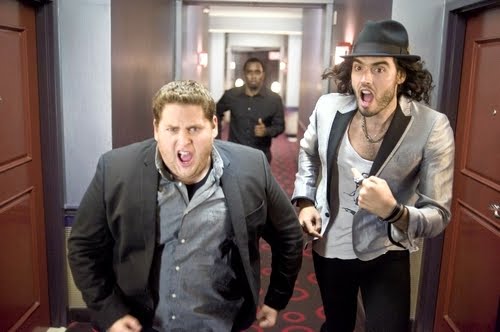
Snow also got married and divorced. After seven years of being sober, he took up drinking and drugs once again. Across the pond and an entire land mass over, Aaron Green (Jonah Hill) is a rising executive at a record label with a doctor girlfriend (Elisabeth Moss) that he rarely has time to share a moment with. Green is what Hill’s character in “Sarah Marshall” (who is totally different) would have become if Snow actually ever listened to his demo.
But the music business is changing. Green’s boss Sergio (Sean ‘P. Diddy’ Combs), who is always mad about something, wants a game changer. Green suggests the winning idea: bringing back Snow to do a show at the Greek Theater in Los Angeles. The only catch is, Green has to get him himself and bring him from London to New York to Los Angeles in just 72 hours. Basically, it’s a good set-up that makes room for even better jokes.
The humor of “Get Him to the Greek” stems from a mixture of awkwardness and over-the-top gags. Sometimes, these two styles interact with one another. The awkwardness works because the actors play the characters that way, and the slapstick works because it’s well directed.
Yet, the one comedic aspect of “Get Him to the Greek” that could be considered close to brilliant is its satire of the music world and entertainment industry in general. Snow’s songs are always laced with innuendos. At another moment, Sergio plays the music he thinks will sell right now. It’s basically just a string of curse words, but it sounds nearly identical to modern mainstream rap. Satire is at its best when it seems too ridiculous to be true, but too truthful to be just a joke.
Like most of the other films in the Apatow oeuvre (Judd produced this), there is a strong reliance on the actors. And the actors deliver. This is Hill’s first true lead performance (in “Superbad” I’d say it was a co-leading performance), and with it he proves that he’s more than just the creepy guy in the background who does cringe-worthy things. What this kind of comedy needs to work (besides good jokes) is relatable characters. Green’s uptight nature feels genuine and not forced. Hill works to make him not only likable, but also hatable. He’s nice when he should be, and extremely selfish when he should be. Moss is essentially playing Peggy from “Mad Men” yet she adds a dash of humor to it which makes it very effective.
So Hill may be a great leading man, but there are two absolute scene stealers here. I thought from the time I first saw “Sarah Marshall” that Aldous Snow was a character worthy of his own movie, and he finally got it. He is transformed from ex-druggy musician to a character worthy of being in “Spinal Tap.” Some might call Brand’s performance effortless, because he is essentially playing himself. However, I enjoy performances like that because what it really means is that no other actor could play this character. It belongs distinctly to someone.
Brand makes the character real by adding little distinct features to him such as a pretentious way of pronouncing words and an even more pretentious walk. While his character is a huge jerk most of the time, there are little moments that make him seem relatable. Making a caricature relatable is what should be defined as fine acting.
I agree with many who are saying that Diddy’s Sergio deserves a movie of his own. His character is too big, bloated, and hilarious for one film. Diddy channels the angry boss role flawlessly. His performance reminded me of a variation of Malcolm Tucker from “In the Loop” with less of a good reason for being so angry all of the time.
“Get Him to the Greek” is written and directed by Nicholas Stoller. Like he also displayed in “Forgetting Sarah Marshall,” Stoller has this amazingly rare talent of creating a huge ensemble full of three dimensional characters.
While some of the backstories in “Greek” certainly don’t feel as original as the ones in “Sarah Marshall,” they no less bring understanding to the characters. And why, do you ask, is backstory so important in a comedy? Because it’s easier to laugh with people you like than people you despise. Green could’ve been nothing more than a selfish, cold businessman. Snow could’ve been nothing more than a self-absorbed and emotionless rock star. Yet, “Greek” is better than that. It doesn’t need to stoop down to that level.
“Get Him to the Greek” lacks some of the finer points of its predecessor, yet I find few things here I could really complain about. In a summer season that has so far been pretty tepid, “Greek” seems less interested in trying to sell something to you and more interested in actually trying to give you a good time at the movies. At that I say, it nobly succeeds.

Movie Review: MacGruber

To my absolute greatest shock I will say: after a dry spell, someone was finally able to make a good “Saturday Night Live” movie. All it took was some inspiration, and a guy who is involved with the existence of “Hot Rod.”

It’s funny how one of the funniest “Saturday Night Live” movies has come from what is usually one of the least funny sketches. That might be harsh. “MacGruber” is usually funny with the right guest, but usually they kind of just thud. Maybe because the concept, not the execution, was so rich that they were able to make the movie version of “MacGruber” this good.
“MacGruber” can be defined as a satire that’s tonuge-in-cheek, but is not too showy about it. If you haven’t seen the skits, the titular MacGruber (Will Forte) is a secret agent that’s a riff on MacGyver. Like MacGyver, MacGruber is known for making weapons out of random household objects. However, MacGruber sucks at this. Also, he acts like a huge, pompous jerk to everyone he meets. Once again, his weapons don’t even work.
For some reason though, MacGruber is actually widely revered and feared for his skills. In a Ramboesque opening, MacGruber is forced to come out of hiding to foil the evil plans of Dieter Von Cunth* (Val Kilmer). Slo-mo shootouts and dramatic montages ensue.
In a way, it sounds like I just described a mediocre action film. Well, I was. I was also referring to “MacGruber.” While most directors seem to believe that satire comes through lame mimicry, Jorma Taccone, John Solomon, and Forte know that true satire comes through a mix of imitation and originality. The character of MacGruber is both a satire, and his own separate entity.
“MacGruber” has followed suit of several comedies made in the last few years and managed to bring out the 1980s. I never experienced a single year of the 80s and I used to look at it as kind of a joke, but now it isn’t. “MacGruber” might poke fun at 80s action films, but in a very meta way, it becomes one. The wink is so subtle that you won’t even notice it. I would put it more into the category of “Black Dynamite” rather than “Hot Tub Time Machine.” That’s part of what makes “MacGruber” such a great filmgoing experience: it asks for those with a great eye for cinema.
“MacGruber” seems like an 80s action film in its over-the-top action and even more over-the-top storytelling. In “MacGruber” these two elements are maximized to be both ridiculous and endearing. Mainly ridiculous though.
“MacGruber” allows its hero to embody nothing but the worst of the typical action hero. He has that pompous, bossy personality, but he just isn’t a real hero. He always says he has a plan, but that plan always falls apart. He thinks he can make gadgets with anything he finds, but they always fall apart. MacGruber is essentially one of the least likable comedy characters I’ve seen. Even Austin Powers knew how to shoot a gun.
For those who grew up in this era, “MacGruber” will be seen as a great piece of nostalgia. For those who didn’t, there’s still more than enough humor for anyone to thoroughly enjoy. Since it comes from The Lonely Island team, the humor can best be described as absurdist and extremely awkward. It is visual and very situational. One such example involves a scene in which the always great Kristen Wiig as Vicki St. Elmo tries to order a cup of coffee in a MacGruber disguise. She back tracks, and perfect mumbling awkwardness follows.
Meanwhile, Forte is very obviously taking advantage of the lack of TV censors. “MacGruber” might’ve even pushed some MPAA boundaries in the process. Most of the excessive sex and cursing is not for shock value, or just for the sake of it, but mainly because it is actually made funny.
Forte’s “Saturday Night Live” career might be coming close to an end, but he has true potential in the movies. He could carry the weight of a story for 90 minutes and create a unique character. Everyone else in the cast manages to bring something, even if it is small, to the table. Wiig proves as always that no one does awkward quite like her. Ryan Phillippe does some surprisingly good comedic work making fun of the straight man who does nothing but tell the hero he can’t do whatever he’s doing.
What should be considered something of a career comeback, Kilmer shows that his greatest skill lie in comedy. He both looks and acts like a villain on the level of Hans Gruber, mixed with that bad guy with the pony tail from “Kindergarten Cop.”
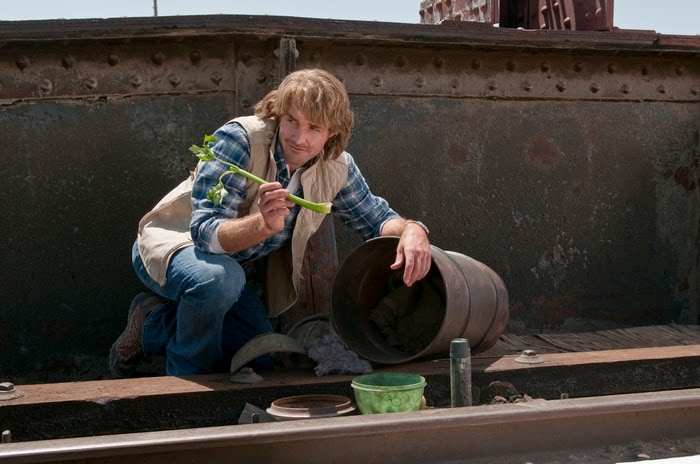
While most have been panning it left and right, I feel like “MacGruber” is by far the most enjoyable film I’ve seen this summer. It deserves to be mentioned with the other successful “Saturday Night Live” adaptations: “The Blues Brothers,” and “Wayne’s World.” It wasn’t trying to impress us. It wasn’t hiding any agenda (mainly, a sequel). It’s simply doing what it can to make us laugh. Whether that be in a ridiculously out-of-place car, or an unorthodox use for celery, it worked.
*Note: Yes, I’m aware.

Movie Review: Babies

Babies. Those little bundles of joy. Those little creatures who can also terrorize your life. Do they really deserve their own film? “Babies” manages to prove that, beyond the cries and the screams, their is depth.

Despite running well under 90 minutes, “Babies” is quite the epic of a documentary. It spans three continents, four countries, and multiple years. The point of the film is to document the beginning of a human life in every part of the world. One baby comes from a small village in Namibia. Another comes from the Mongolian steppes. In contrast, the final two come from the bustling urban metropolises of Tokyo and San Francisco.
French director Thomas Balmes guides the audience through the critical stages of an early life. Much time is spent on birth, first words, and of course, the first steps. Despite devoting much time on these important moments, Balmes does a very French thing and brings us through many small moments that have no true impact on a life, yet are so poignant for that reason alone. One of the most memorable of these moments include the Mongolian baby waking up to find a rooster in his bed. It’s never mentioned again, and it does nothing to show the baby growing up, yet its just so unique in how much detail is paid to that one little snippet we never see again.
There is one thing “Babies” truly has going for it: how expertly edited it is. Balmes likely had hundreds of hours of remarkable footage to use, and certainly a wonder how he was able to narrow it down to just 79 minutes. It must’ve been a painstaking process, yet he certainly took all of the effort to choose exactly all of the right shots.
The editors also knew quite well how certain shots and scenes should align with one another. Many are placed next to each other to either show differences or similarities. We see that in every culture, sibling rivalries exist. We also see that in every culture, each mother has her own way of teaching her child about the world. This supports the film’s main idea: everyone is brought into the world blank, and comes out differently from what they see, and what they experience. It’s a simple idea that’s supported with the help of a lot of complex imagery.
Yes, that imagery. It’s striking. While it’s always interesting to see what the babies are doing, Balmes likes to explore the territory they’re in. He finds us a river in the middle of the Namibian desert, and a lush park amongst the urban sprawl of Tokyo. These shots, the ones we never see, are the kind of shots a good documentary filmmaker should capture, and never let go of.
If there’s one complaint most people seem to have about “Babies,” it’s that it’s virtually devoid of any speaking. There is some background speaking, but mainly there’s the mumbling and grumbling of the babies. This factor serves to be both a positive and negative aspect of the film. I don’t think it would’ve been much trouble for Balmes to add in subtitles or just a short voiceover to at least explain a few things. Because these things are missing, the film, at times can just feel like a compilation of home movies.
However, when examining the film from a more critical perspective, perhaps this was done in order to make the world as fresh, new, and confusing as a baby would see it. Perhaps that lack of dialogue is to fully emphasize the action occurring on screen, and allowing character to build through these actions. Maybe Balmes wanted the moments where the babies first walk to feel like skeleton thrashing scene in “2001: A Space Odyssey” or the scene when Daniel drags himself out of well, leg broken, in “There Will Be Blood.” At a point like that, who cares what some dialogue could say about it? The images speak for themselves.
“Babies” does exactly what it sets out to do: show the things that make us different and make us the same through the use of babies. If you were looking for the interior monologue of a baby, then maybe you should watch “Baby Geniuses” instead. “Babies” is an exploration of the beginnings of a human mind. It’s like “March of the Penguins” for babies.

Movie Review: Robin Hood

Ridley Scott, where are you? The credits for “Robin Hood” say your name, but not a single one of your directorial trademarks are at all present. “Robin Hood” is not a movie, it’s a mess. It makes “The Room” look coherent.

The story of Robin Hood is folklore that’s been passed down for generations. It’s the famous “steal from the rich, give to the needy story.” Even Scott can’t seem to get that straight.
What can be deciphered from the muddled plot is that “Robin Hood” is the story of Robin Longstride, a.k.a. Robin Hood (Russell Crowe). Robin Hood is a skilled archer in the army of King Richard the Lionheart (Danny Huston) during the political instability of 13th century England. After King Richard dies, Robin Hood travels to a small English village where he encounters corruption, a crippled taxation system, and a lonely yet strong widow (Cate Blanchett).
Besides encountering love, Robin Hood makes time to return a sword to his rightful owner, and battle the pesky French, all while managing to be one of the least engaging Medieval warriors I’ve ever seen.
Robin Hood is a mythical person, but he is one that has been emphasized over the years with so much detail that some might think he was real. You wouldn’t know it from this version, though. The free-spirited, anarchic outlaw that this film wants to portray is not visible once. In fact, the title character at times seems to disappear in the background. At times, he’s rendered totally insignificant. If a film wants to portray its hero as such an important figure of its made up world, than it should actually try to do just that.
I look back at “Robin Hood” and I realize, there wasn’t one redeeming feature to somehow lift this movie up. I always try to find that one redeeming feature of every poorly done film to prove that no matter what, nothing is perfect. Yet, I still can’t find it here. Maybe the one redeeming feature is the potential. “Robin Hood” holds a talented cast, and a talented director, yet nothing holds up.
The weakest point of “Robin Hood” is definitely its screenplay. No plot points seem to connect, no characters are related to each other in important ways, and not a single line of dialogue is the least bit memorable. The film ultimately amounts to two hours and twenty minutes of British people arguing about tax code in the dullest way imaginable.
“Robin Hood” is a summer blockbuster. I know that, and the film knows that. It looks like a summer blockbuster, but it just isn’t one. There is barely a battle sequence to be found here. Then, whatever action that is to be found here is impossible to even follow. Not to mention, every kill seems meaningless because Scott seems to prefer going into battle without much context. Why are the British battling the French? Why are the British now battling each other? Taxes, I guess.
There is a difference between a good summer blockbuster, and a great one. A good one contains the kind of action that is entertaining and satisfying. A great one contains action that is enthralling and sometimes mesmerizing. “Robin Hood” falls into neither category. This is bizarre, as this comes from the mind of a truly great action director.
There is not a single moment in which “Robin Hood” feels like a Ridley Scott film. It lacks the graceful action that won “Gladiator” Best Picture. It also lacks the amazingly realized universe of “Blade Runner” and the truly brave and three dimensional hero of “Alien.”
Instead, “Robin Hood” tries way too hard to capitalize off of the success of “Lord of the Rings.” Rather than coming off like “Lord of the Rings,” or even “Braveheart,” it feels more like “Monty Python and the Holy Grail” meets an intense LARPing match. Yet, the characters in a LARPing match are more well defined.
The one thing that continues to bother me about “Robin Hood” is the wasted potential. Besides the great director, it contains a sprawling cast (which contains the legendary Max von Sydow, who’s been around long enough to work with both Martin Scorsese and Ingmar Bergman). Even Crowe and Blanchett are reduced to merely mumbling. There is even a scene where Blanchett gives an unimaginably unrealistic response to the death of a family member. Crowe is forced to do the cliche “NOOO!” scream. Is that how two Academy Award winners are supposed to be treated?
I will try my best now, to give the film some sort of praise. It might be a little backhanded, but its something. The barrage of arrows at the end was pretty well done, even if it was a blatant ripoff of a stupid scene from “300.” Meanwhile, Kevin Durand (Keamy from “Lost”) does a fine job in his role as the oddly named Little John. He is the only one who seems to be enjoying his role, and the only one who seems to be in the right movie.
Besides that, the rest of the movie is basically the Knights Who Say Ni. I’d have given the film some sort of pass for effort but for a director who’s known to be an intense perfectionist, its shocking that so little effort has been put into this version of “Robin Hood.” Whether this is the fault of an intrusive studio, or a lazy director and writer is up to interpretation, but one thing about the legend of Robin Hood can be said: the version with the fox is better.

Movie Review: Iron Man 2

I might’ve enjoyed watching the superhero genre be mercilessly mocked in “Kick-Ass,” but I’m no hater. I’ve been anticipating “Iron Man 2″ ever since the moment the first movie ended. This one comes with some minor disappointments and a few major promises. While I can certainly recommend “Iron Man 2,” there isn’t enough to truly give it flat out praise.

“Iron Man 2″ leaves off directly where the first one left off, with weapons connoisseur Tony Stark (Robert Downey Jr.) admitting to the media that he’s Iron Man. The world has changed since then. Thanks to Stark’s design, the world is now safer. For now at least. The movie catches Stark at something of a crossroads in his life: he’s more successful than ever, yet the same technology that’s kept him alive is now turning against him. He becomes more and more narcissistic than ever.
While Stark remains in denial that the Iron Man technology can ever be doubled, someone looks to do just that. There’s Justin Hammer (Sam Rockwell), an even more smug version of Stark who’s looking for a job in the Pentagon, and psychotic Russian physicist Ivan Vanko (Mickey Rourke) who’s seeking revenge on Stark for past injustice.
One thing I must hand it to director Jon Favreau for doing is putting his own comedy background into an action film. His natural eye for comedy always adds a good extra entertainment value to the “Iron Man” films. The brand of humor he incorporates here probably wouldn’t be a good fit for a Batman or Spider-Man film. However, this particular story involves a character who’s CEO of one of the biggest companies in the world, yet he’s still willing to call a senator a jackass.
In Favreau’s strength, unfortunately, lies his weakness. While he knows his way around humor, he just couldn’t quite nail a lot of the action here. Strangely though, he seemed to know what he was doing in the first movie. In “Iron Man,” some of the war sequences had an odd sense of realism while the scenes where Stark was just mastering his suit were sometime even quite graceful. Here, much of the action was either too silly to take seriously or too quick to ever appreciate. I call it the “Quantum of Solace” complex: a sequel to a great action film which looses hold of the great action of the original.
Take for example, the final battle. I’ll do my best to spare the details. What I will say is that for a battle built up so much, in a location so tight, it turns out to be a major letdown. It’s as if the whole scene, the whole plot line, was simply to end with a giant laugh.
One of the main factors that keeps “Iron Man 2″ from falling apart is its superb cast. Downey is almost too perfect for the part. Only a free spirit like him could portray a free spirit like Tony Stark. But unlike the first film, “Iron Man 2″ adds a level of emotional vulnerability to Stark. He’s certainly not the Messiah he once thought he was. Downey manages to balance that fine line, without turning Stark into a total contradiction.
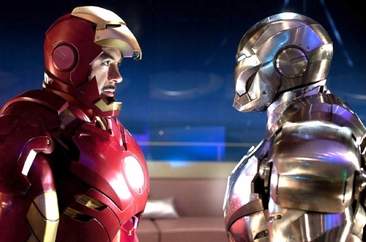
Then there are a few supporting actors truly worthy of recognition. While this film suffers from a loss of The Dude, it makes up for it with the presence of Mickey Rourke. Call it a stretch, but his performance reminded me somewhat of The Joker with more motivation. He always seemed to take such ease in being such a psychopath. While I can sometimes be annoyed by too much backstory for a villain, here it’s used simply to show motivation rather than to create unnecessary sympathy.
But I digress. Rourke shows here why he’s such a great actor. He is an actor who needs no direction. All he needs is a character description, and he makes it into his own (his odd relationship to his bird was all his idea). The only problem is that Rourke is given such limited screen time. Maybe with a little more freedom, and a little more time, Ivan Vanko would’ve been even more of a villain to remember.
Yet another scene stealer is the even better Sam Rockwell. He taps into all the anger, frustration, and even dark comedy that define his other performances (especially in “Moon”). His character differs from most other villains of superhero mythology because he doesn’t achieve evil through highly advanced weapons or murder. Rather, he is so creepy because he’s such an egomaniac that he will resort to literally any means to get to the top. View him as a much less intelligent version of Hans Landa.
While the cast is sprawling, one problem is that many are either underutilized, or are just plain useless. No offense at all to Gwyneth Paltrow, but her performance mainly consists of her yelling “Stop!” and “Don’t!” at Tony. While Scarlett Johansson’s Natalie Rushman certainly has a little more purpose than that, her role in the film would’ve been better in another sequel.
Again, “Iron Man 2″ is a film I can recommend, but only give slight praise to. It can be hard to give a movie a passing grade for entertainment value alone, but “Iron Man 2″ manages to deliver a solid two hours that never has a dull moment. Yet, with the high standard set by recent comic book films (“Spider-Man 2,” “X-Men,” “The Dark Knight,” “Sin City”), “Iron Man 2″ could’ve been a lot more. And with the extreme likelihood of a third film, Favreau and the “Iron Man” crew should stick to the factors that made the first film great rather than the ones that made the sequel decently mediocre.

Movie Review: Kick-Ass

Remember those people that always said that you should never be the hero? They never told you why: because you might get knifed repeatedly before being mixed up with a bazooka and some samurai swords. Thank you for that valuable lesson, “Kick-Ass.”

All joking aside, “Kick-Ass” is a grand new addition to a genre of meta satire where the story becomes both satire and the subject in which it is actually satirizing (on purpose, of course).
The subject being satirized in “Kick-Ass” is a hybrid of the worlds of both comic books and movies. In order to dive into this world, “Kick-Ass” uses Dave Lizewski (Aaron Johnson). Dave is the archetypal comic book hero pre-transformation: he’s a nerdy teenage outcast with girl troubles. Dave escapes his miserable, almost meaningless existence through an extreme comic book obsession.
Dave’s obsession goes a little too far when he believes being a hero is as easy as putting on a costume, so he sets out to rid the streets of crime. Despite becoming a pop culture phenomenon, his super hero name is Kick-Ass not because he wins every fight but rather because he always seems to get beaten to a pulp.
“Kick-Ass” has what is almost two interwoven plots. The two plots serve as the two separate films “Kick-Ass” strives to be: a comic book movie, and a comic book satire. Dave’s transformation into Kick-Ass serves most of the film’s satirical moments. These moments serve to tell us that the great heroes such as Spider-Man, Superman, and Batman were kept flat on the page for a reason. These heroes served as fantasies for a reason. That reason is that they’re not supposed to exist in reality.
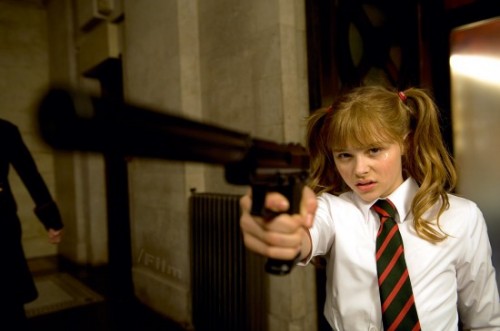
There is another part of “Kick-Ass” that always remains funny, yet also tries to be like a true comic book. The film gives us the dynamic duo of the young, foul-mouthed, and very skilled Hit-Girl (Chloe Moretz) and her weapon-loving father Big Daddy (Nicolas Cage). Wherever they fight crime, they leave an extremely gory trail behind.
“Kick-Ass” has generated a lot of controversy for its sometimes less-than-serious look at ultra violence. To simply dismiss it as a product of violence-loving culture would be to totally miss the point. “Kick-Ass” comments on a society enamored by superheroes and explosions by in a way, becoming a very product of it as well. For example, Hit-Girl’s shocking fighting techniques might produce laughter. This isn’t because the act of murder is supposed to be funny but rather because these moves are all carried out by such a young child. One of the most important rules of comedy is breaking away from the expected. Then again, the often humorous view shows how little the characters understand reality.
Not all of the violence in “Kick-Ass” is pure humor. Director Matthew Vaughn has a Tarantinoesque ability to balance out over-the-top violence with much more realistic (and even dramatic) violence. Nobody gets injured and then heals instantaneously. Vaughn never neglects to remind the audience that in the end, these are just a bunch of inexperienced kids fighting people with guns.
“Kick-Ass” is supported by a flawless cast. Johnson creates a neurotic persona so awkward that it manages to rival the reputation for awkwardness created by co-star Christopher Mintz-Plasse. It was nice to see Nic Cage actually acting for once, or better yet actually playing a character fine-tuned to his own personality. He’s had too long of a streak playing characters abusing women while wearing a bear costume.
Of all the cast, the biggest standout was the most inexperienced actress. Moretz handled such a gutsy role with such gusto. She gave off the sort of ease and believability that only a pro could ever pull off. Despite having such a small role, Moretz turns Hit-Girl into the funniest and most memorable character of the film. She’s even worthy enough of her own spinoff.
The reason that “Kick-Ass” is my favorite film so far this year is because of how courageous it truly is. In this day, it’s hard to make a movie that truly feels daring, that feels as if societal norms were broken in order to make it. “Kick-Ass” is that rare film that seems like a shock that anyone ever produced it. It contains violence that is at times uncomfortably gruesome and at other times uncomfortably funny. It even uses a four-letter word that is still taboo to say.
Yet, the film is never shocking for the sake of shock value. It is shocking because it earns the right to be shocking. It’s shocking because parts of it feel like the kind of story you’d hear on the local news at 11, and then later watch it become a YouTube phenomenon. It’s daring in both its hardcore violence and its storytelling. Vaughn carefully balances both realism and jet pack absurdity into one film. It’s stylish and ridiculous at the same time.
In a world where people can watch movies on laptops and phones, “Kick-Ass” feels like the kind of film that was made to be see in a theater. Its unique story is worthy of a variety of responses. One scene can make some happy, and others angry. It’s also shot well, and contains some humor that works best in collectivized laughter. “Kick-Ass” has something to say and something to give. It’s both a disturbing look at the world, and a hilarious comic book fantasy. Genius couldn’t have come in a more stylish, more fascinating package.

Movie Review: Trainspotting

At this point, I should not be surprised to see a Danny Boyle film that starts and begins with action. Or, in the case of “Trainspotting,” begins in the middle of action. That’s the pace of the film, the mood of the film, and the setting of the film, all introduced in a few short seconds. If you can’t keep up, you were never meant to watch this film. If you can, be prepared for one of the most rewarding viewing experience you might ever have.

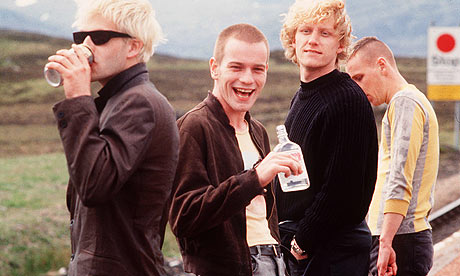
“Trainspotting” was the breakthrough film of the energized British mind of Danny Boyle, perhaps best known for “Slumdog Millionaire.” Here, the slums of Mumbai are replaced by the drug scene of Edinburgh, Scotland. Boyle focuses on a small group of heroin addicts, who live as a small, twisted, alternate family.
The circle of friends include the timid Spud (Ewen Bremner), honest Tommy (Kevin McKidd), almost pensive Sick Boy (Jonny Lee Miller), borderline psychotic Begbie (Robert Carlyle), and Mark Renton (Ewan McGregor). Renton is the film’s central character. The film mainly follows his quest from junkie to ordinary man. His conflict is to make it to sobriety without being pulled back into the past.
“Trainspotting” proves that Boyle brings a level of energy and thrill to cinema that few directors nowadays can match. He can achieve this high level of energy simply by tilting a camera, or adding a little light to a room. It might just be a way to shine a little bit of hope into a hopeless world. However, this doesn’t mean Boyle is attempting to beautify horror. He never justifies his characters’ actions. The film is meant to portray the world inside the mind of a heroin addict, and maybe one person might just beauty in their own mind where others see trash.
Boyle will always remain in my mind a brilliant visual director. He just truly knows what a good image would look like. And while some visual directors opt forr long stretches of silence, Boyle can let soliloquies run long over stunning images with no sense of distraction. Both of these things make one of those combos that just inexplicably work so well together. Boyle is the rare director who can be in-your-face without being annoyingly intrusive.
While Boyle is overwhelmingly a visual director, he still can stay in touch with emotion. Through many odd, trippy sequences, Boyle explicitly shows the inner workings of a drug experience. Then, he shows how these experiences have the power to dehumanize and tear people apart.
Of all the characters in the large ensemble of “Trainspotting,” Renton is without a doubt the most important, and the most deep. He is the one character the audience can cling onto emotionally because he is the only one seems to have the ability to change. Renton is extremely dark; he rejects every aspect of materialism along with his own heritage. He doesn’t seem to do drugs out of addiction but rather out of the pure thrill of life. He definitely adheres to the quote that opens up “Fear and Loathing in Las Vegas”: “He who makes a beast of himself gets rid of the pain of being a man.”
The inner pains of Renton are brought out by the outstanding performance of McGregor. He disappears into his role and never steps out of it. He shows an untrustworthy inner demon. Yet, his capacity to change is utterly believable.
Some might compare “Trainspotting” to a modern film about the effects of drugs such as “Requiem for a Dream.” However, I will instead compare it to one of cinema’s greatest masterworks: “A Clockwork Orange.” I am not saying “Trainspotting” is as good as “A Clockwork Orange,” but I can feel that Boyle was trying to emulate Kubrick’s classic and he does so well. The large white walls that engulf characters, the aloof parents, and the endless graffiti feels totally reminiscent of the world of Alex DeLarge.
Like “A Clockwork Orange,” “Trainspotting” is about the possibility or impossibility of change in a world that’s in a constant state of moral decay. This is a film that tells the typical anti-drug fable with a hip new eye. Sometimes that’s just what the greatest movies are, they ones that tell the stories we’ve heard millions of times before and makes them brand new. Oh, and in the case of “Trainspotting,” simply brilliant.

Movie Review: Greenberg

Sometimes when you’re angry at the world, it’s not the world you should be angry at, but rather, at yourself. It takes a lot to portray subtle self-loathing. “Greenberg” does just that.

Despite what you may think, “Greenberg” is far away from being a comedy. Yet with a director like Noah Baumbach, there are still traces of humor in the air.
Another surprising thing about “Greenberg” is that it’s title character, and the one seen on every poster, is not quite the main character. Who may be our real protagonist (or in my view, the first protagonist), is the character seen first in the movie. The first protagonist is Florence (Greta Gerwig). Florence is the nanny of the Greenberg family. She has potential but barely utilizes it. She seems pretty content with herself.
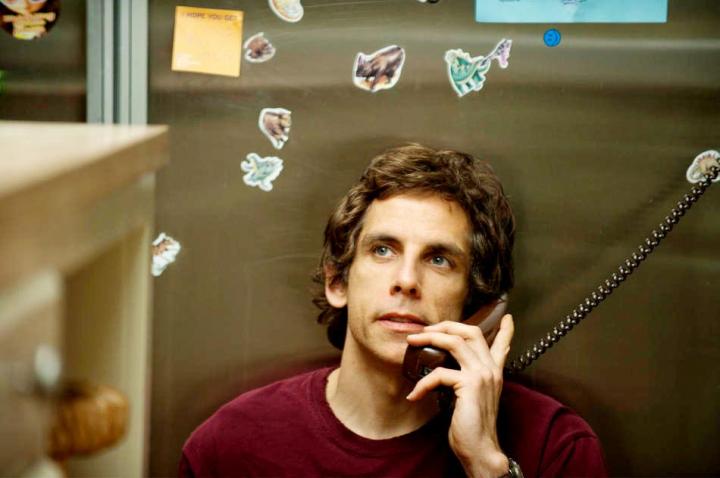
As the Greenberg family heads on vacation, the father’s brother Roger (Ben Stiller) comes to stay at the house after having recently been let out of a mental hospital. He’s not actually insane, he can just act like it sometimes.
With “Greenberg,” Baumbach leaves his hometown of Brooklyn and replaced it with sprawling, smog-crowded Los Angeles. While the characters of his film “The Squid and the Whale” could seem so distant even though they were always so close, the characters of “Greenberg” seem so incredibly distant both physically and emotionally. Baumbach is a great director in utilizing setting for substance. He uses it not only to show emotional distance but also to later disprove the practicality of Greenberg’s lifestyle, which is a philosophy of doing absolutely nothing.
Baumbach has also proved himself an excellent director by pulling off the littlest things with such great care. He has a few excellent shot choices that last just seconds yet are still effective. One of those might be that directly behind the ears shot of a dog walking, with the afternoon light glowing down overhead. Baumbach can also pick an excellent soundtrack.
Oh, and he’s a fantastic writer. He’s a lot like a Wes Anderson clone, in a good way. He excellently tackles egotism by showing certain people’s self-centered lives in relation to the world they inhabit. Most directors might portray narcissism through a first person perspective, but Baumbach is too creative for stooping to that.
Baumbach achieves this by telling the story loosely from Florence’s perspective. I say loosely because she doesn’t inhabit every scene and we don’t even get narration from her. She’s never as developed as Roger yet she always seems to be an overwhelming presence in the film. He even manages to balance out her own presence by adding in the perspectives of the other people involved in Roger’s life. That, there, is how you can develop a full cast of characters in under two hours.
Even with the varied cast, and even with a different title character, I am always drawn back to Florence. This is mostly because of Gerwig’s performance. She’s been in so little before this but I already think she deserves an Oscar nomination. Her character is made up of awkwardness and quirks. Yet, she avoids turning Florence into an M.P.D.G. (manic Pixie dream girl), and instead turns her into someone filled with deep pain that we’ll just never understand. Sometimes, she feels almost too real to be acting.
Then, of course, there’s Stiller. It would be dumb to say that this is his big triumphant foray into dramatic acting. Frankly, his performance as Greenberg is very similar to his performance in “The Royal Tenenbaums.” I mean nothing negative by saying this. I think though what Stiller’s performance here proves is why comedians are perfect for drama: the most important things in life are usually just too funny to take seriously. For example, Adam Sandler took all the rage he used for laughs in “The Waterboy” and just made it more serious in “Punch Drunk Love.” Stiller is always funniest when he is portraying unexplained narcissism and resentment. Here, Stiller is doing what he’s always done in movies such as “Zoolander,” “Tropic Thunder,” and even “Heavyweights.” This time, it’s just shown from a more mature angle.
What I also enjoyed about “Greenberg” is how Baumbach connects these two characters. They both just seem to be two parts of the same person. However, a little more depth is given to Roger. He is such an unlikeable character. He projects the kind of hatefulness that only an antagonist should show. Baumbach never attempts to justify his actions, but just simply show he might just learn and become a better person from the terrible things he does.
“Greenberg” is a great redemption story because a character is shown who truly needs redemption more than anyone else. However, the world around the character is never shown as being moral or flawless either. Everyone is equipped with their own set of problems. When everyone is dragged down to the same level, it is then that sympathy can be felt for an unlikeable character.
With “Greenberg,” Baumbach shows that he’s a great story teller simply because he can take the right story, and utilize it in the right way. A good film isn’t just about the story, but about how that story is handled. When it comes to turning narcissism into self-hatred and cliches into originality, look no further than the creativeness of this fine auteur.
If You Liked This Movie, You’ll Also Like: The Squid and the Whale, The Royal Tenenbaums, Rushmore, The Graduate, Rachel Getting Married, Sideways