Category Archives: Movie Review

Movie Review: Moneyball

Does every sports movie have to end with a victory in order to inspire us? If “Moneyball” teaches us anything, it’s that a failure is just one small step on the road to success.

The sports movie formula has become a giant cliche: assembling the team, training, and then against all odds, winning (usually in slow motion). “Moneyball” does right in veering from this formula, but its biggest folly is that it thinks it’s the smartest sports movie ever made.
I guess this could only occur in a movie about Billy Beane. Beane, portrayed with ever relatable qualities by Brad Pitt, was general manager of the Oakland Athletics in the early 2000s. He joined as the team was about to lose Jason Giambi and Johnny Damon. Beane was looking not only to turn his team around, but to totally change the game (pun intended).
On a trip to Cleveland, Beane meets a young, Yale-educated analyst for the Indians named Peter Brand (Jonah Hill). In a secret “All the President’s Men” style meeting in a parking garage, Brand shares his unconventional method of finding players: judging on the numbers rather than the looks. The fact that all of the talent scouts were well into their 60s shows how out of touch management was with the actual game.

So Beane takes Brand away from Cleveland and the two apply his new system to the A’s. The statistic-based way of recruiting angers many and takes a few hits to the team’s reputation. Beane builds up a team of outcasts and misfits, and through some training and semi-inspirational speeches, the A’s pull off the longest winning streak in Major League Baseball history.
“Moneyball” is less about the actual game and more about what happens behind-the-scenes of the game. As someone who never got too into sports, it speaks great volumes of how invested this movie got me into baseball, if only for this two hour span. There are more brains that goes behind creating a good team than I ever could have imagined. Some of the logic is still a little fuzzy to me (I don’t have a mathematician’s brain), but the fact that it works is absolutely fascinating.

This is also where the film faults the most. “Moneyball,” written by Aaron Sorkin and Steven Zaillian, lacks the absolute clarity that Sorkin injected into “The Social Network” that made the world of computer programming so intriguing. Sorkin should have written this one by himself. Zaillian, while a talented writer, tries to put in the same sentimentality that defined most of his other screenplays such as “Schindler’s List” and “Gangs of New York.”
It wouldn’t be shocking if adding the relationship between Beane and his daughter was Zaillian’s contribution. This wasn’t a terrible addition, as it makes Beane seem more relatable. However, there is no real conflict put into this relationship, as well as in Beane’s relation with his divorced wife. Therefore, this whole plot line just feels thrown in, and the ending isn’t as moving as it should have been. It also takes away from the goal of making “Moneyball” reminiscent of a 70s thriller. That little girl really can sing, though.
“Moneyball” might just miss the mark, and it might suffer from Multiple Ending Syndrome, but it is still a solid, if not spectacular, two hours of entertainment at the theaters. The real highlight of the movie though, is Jonah Hill. Comedic actors give their best turns in dramatic roles when they still act like they are in a comedy. If I could give one more compliment to “Moneyball,” instead of all out dissing it, I’d say it has great comic relief.
Movie Review: About Schmidt

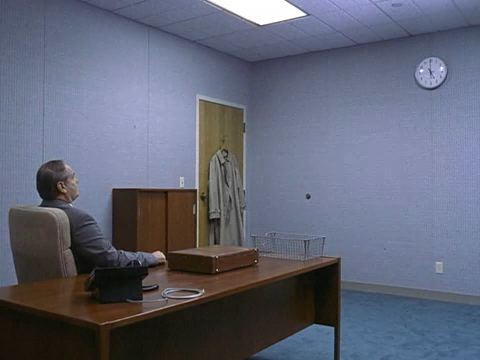
It’s almost 5 o’clock on some weekday and Warren Schmidt (Jack Nicholson) is on his last day of work before retirement. He’s not so much paying attention to the paperwork on his desk, but rather for the very second that the clock strikes 5 PM and he’s a free man. Then again, this was probably what every single day of work was like for him.

I think it would be a gross generalization to say that Warren Schmidt, the titular character of “About Schmidt” is no different from me and you, as there are many things that make me and you different. Rather, he begins the movie with no unique characteristics to establish him. He is vice president of an insurance company, working in a blank office in a plain, white skyscraper. Later, we will find out this was never the job he hoped to end up with.
Warren then goes home every day from work to a wife (June Squibb) he doesn’t think he loves enough and a daughter (Hope Davis) who is marrying a deadbeat (Dermot Mulroney). The Schmidt household is a picture of lost potential.
Warren’s life post-retirement has come down to a single Winnebago, the one he will drive cross country to his daughter’s wedding. But Mrs. Schmidt suddenly, inexplicably, drops dead. This drives Warren into a second, even worse rut. But still, he must embark on that cross country road trip. Most say that long trips are best made with a companion. Well its a long road to Denver, and the only thing accompanying Warren are his thoughts.
“About Schmidt,” like just about every other Alexander Payne movie, boils down to a road trip. While his films are usually about how friends or family resolve their differences on the road, making Warren go it alone shows that this is truly a film about a man who doesn’t only need to redeem himself in the eyes of his family, but rather he must redeem himself in his own eyes. That’s why when he begins writing letters to a boy he adopted from Africa, it sounds a lot like he’s talking to himself.
“About Schmidt” certainly isn’t Payne’s best film. No, that honor still belongs to the twisted “Election.” Yet, it captures an essence and a feeling that all of his films try to convey better than anything he has ever done. “About Schmidt” shows that the idea of America lies on the road. This is a country of people who feel the need to explore, from the pioneers to Warren Schmidt. This might sound like too much of an overanalysis but once you see this movie, it’ll make sense.
“About Schmidt” shows in finest form that Payne and his frequent co-writer, Jim Taylor, know how to write natural sounding dialogue like few others working today can. The conversations feel colloquial yet relatable. No matter what, “About Schmidt” always gives off a warm, welcoming vibe, even when the characters act totally detestable.
Usually, a lone road trip would seem dull, and more like in-between time between big scenes rather than an entire movie. But Payne makes Schmidt’s trip a deep, introspective one. While most road trip stories are interesting for what the characters see, this one is most interesting for who our character meets along the way, and the moments they all share together. There is something about the kindness of strangers that can make someone want to tell them anything. Or that is, if you don’t feel comfortable saying anything to your own family.
I said it once before in my review of “The Descendants” that Payne can get established actors to go totally against type, and deliver some of their finest work. Jack Nicholson’s most familiar character is a loud, outcast rebel. In “About Schmidt,” he plays someone facing the consequences of a life of not taking any risks. It is a quieter performance than we are used to seeing from him. He unlocks something in the character that no other actor could in that he takes someone who is so plain and unextraordinary and makes him vibrant and extraordinary. Then, when he finally realizes how little time he has left, and how much of life there is to enjoy, his revelation feels earned rather than contrived.
For that main reason, the ending of “About Schmidt” feels right when it could’ve felt wrong. I am not saying that “About Schmidt” is going to change your life, as that is not the point of it. Rather, it might just make you want to look around, appreciate where your from, and then do something you wouldn’t normally do. How often does that happen?

Movie Review: The Descendants

Seven years ago, Alexander Payne dispensed a masterful romantic comedy called “Sideways” on us. Then, he all but disappeared, meaning that for seven long years theaters lacked the likes of Jack and Miles and Tracy Flick. Finally, Payne’s fifth feature as a director, “The Descendants” has hit theaters, and it’s the kind of film Payne must have been working toward his whole career to make.
Payne’s early Omaha-centric films lent themselves perfectly to dark comedies, thanks to the always cloudy midwestern location. After checking out Napa Valley in “Sideways,” Payne jumps across the Pacific to Hawaii for “The Descendants.” This is Payne’s darkest film. Despite it taking place in Hawaii, George Clooney’s Matt King makes it clear from the very beginning that just because they live in paradise, Hawaiians are not “immune to life.” This is not the sequel to “50 First Dates.”
King is a lawyer, a land baron, and an absent father. Like most of the people around him, he wears a tropical shirt every day. However, rather than conveying relaxation, wearing these shirts just seem to convey stress. King comes home one day to find his wife, whom was always fond of extreme sports, to be in a coma after a boating accident. Not only must he care for someone who is on their deathbed, but also his daughters whom he barely knows.
His youngest daughter Scottie (Amara Miller) turns out to be a precocious mess without the guidance of her father. The oldest King daughter, Alexandra (Shailene Woodley), is a so-called problem child who surprisingly steps up to the plate once her mother isn’t around. Matt’s attempts to rekindle his relationship with his daughters is rough at first, but every minute of the film is a representation of him making a step in the right direction and becoming a better father.
Along the way, Matt finds out the nasty little secret that his wife was having an affair with a real estate mogul (Matthew Lillard), something that Matt’s ineptitude as a husband might have forced her into doing. This all leads Matt to explore one big question: can you forgive somebody who is in a vegetative state?
Just as the eldest daughter must step up to the plate, so does Clooney in this challenging performance, and he definitely delivers, in one of the best roles of his career. Payne has a habit of getting his actors to go against character, and Matt King is the equivalent of Jim McAllister years after he decided to flee Omaha and Warren Schmidt before reaching old age. Clooney is best at playing characters who go through a crisis but this time, he gets a happier, or more accurately, uplifting, ending.
Clooney is an actor who usually gives very commanding performances. His performance in “The Descendants” is a different kind of commanding, the more quiet kind, the kind that could win him an Oscar. His character doesn’t speak in monologues in front of a crowd but rather in long monologues inside of his head. Perhaps he is trying to reach out to someone that won’t listen, or rather justify his own actions in the comfort of his thoughts. Either way, it sends the message that his neglect never came from lack of love. Perhaps a lack of understanding might be a better way to describe it.
“The Descendants” moves at a leisurely pace, making the good times better, and the tragic times more painful. Here is a film that wants its audience to wallow in both joy and sorrow. The audience is given ample time to get to know the characters, and soak in the fantastically convincing screenplay by Payne, Nat Faxon, and Jim Rash (yes, this guy).
“The Descendants” uses its Hawaiian locales to their full potential. While this film dispels the myth that Hawaii is a paradise, it doesn’t shy away from the images of sandy beaches and towering green mountains from the Hawaiian stock photo factory. And why not? While Hawaii is a place filled with hardships like any other state in America, it is still a damn beautiful place to live.
At the core of “The Descendants” is a tragedy that causes many other tragedies. What this film does so interestingly is disconnect its audience from the tragedy. We never do witness the tragic accident that put Mrs. King into a coma, nor do we get to witness her being alive at all (there aren’t even any flashbacks of her provided). It is this disconnect that ultimately makes “The Descendants” such an uplifting film, because in the aftermath of a tragedy, there is a certain unpredictable nature, as if there is nowhere to go but up. And that is exactly what the King family needs. And as an audience member, it’ll make you love this film even more than you thought you could.

Movie Review: The Rum Diary

Before Hunter S. Thompson wreaked havoc at every hotel in Las Vegas in between mescaline trips, he downed shots of rum and turned over hotel mini bars in San Juan.

The novel of “The Rum Diary,” written by Thompson in the late 1950s but not published until 1998, remains one of the defining works of the father of Gonzo Journalism. The film adaptation of “Fear and Loathing,” while a failure upon initial release, is a cult classic. The film adaptation of “The Rum Diary,” written and directed by Bruce Robinson, may have trouble reaching this legendary status. “The Rum Diary” is a nice tribute to the brilliant rebel author, but it fails to capture the obsessive, detailed beauty of his writing.

Johnny Depp once again plays the role of Thompson, this time under the pseudonym of Paul Kemp. Kemp, an alcoholic American expatriate from New York, flees to Puerto Rico where he finds a job as a writer for a failing newspaper.

“The Rum Diary” is, in a sense, the story of how Thompson became a great journalist. At the beginning, he can’t find his voice as a writer. By the end, he realizes he must use his voice to fight against the injustices he finds. The movie only gets halfway into fully developing this point. If you want to see a truly great portrayal of the impact of Thompson’s writing, watch “Gonzo” instead.

Another part of the movie involves Kemp’s encounter with Sanderson (Aaron Echkhart), a rich American businessman living in Puerto Rico with his beautiful lover Chenault (Amber Heard), the continual source of Kemp’s affection. Sanderson’s plan to develop a resort on beachfront property feels less like a fully developed representation of Thompson’s first battle against the “bastards” of capitalism, and more like the plot of an 80s comedy.

Since stumbling upon the original manuscript of “The Rum Diary,” Depp has always been fascinated with Thompson, and turning this book into a movie has always been a passion project for him. In his performance, Depp captures the essence of Thompson through his mumbled voice, which is always moving faster than anyone can speak, and despite almost always being drunk or under the influence of a strange drug introduced to him, his always cognizant demeanor.

Meanwhile, Giovanni Ribisi steals every scene he’s in as as the disgruntled and out-of-his-mind Moburg. His lightning-fast intensity and hilarious characterization should earn him better roles in the future. As Lotternman, Richard Jenkins’s fiery way of speaking deserved more screen time. Sanderson’s intended cartoonish persona and two-dimensional nature makes it difficult for Eckhart to do much with the character. While Heard has the entrancing look of Chenault, her performance comes off as more dull than enticing.

While “The Rum Diary” is about Thompson’s quest to find his voice, the film lacks that voice completely and ends up being a squeaky-clean, Hollywood version of “The Rum Diary.” While the film is entertaining, it lacks both Thompson’s insight and indignation. The greatest absence from the film is of the novel’s haunting final lines, which embody Thompson’s early quest to be F. Scott Fitzgerald in his writing style. These words could have been said in a final voiceover, or perhaps represented by one image. Instead, it resorts to a tidy epilogue, as opposed to exploring the more indefinite freedom of the original story.

And in this lays the movie’s biggest problem: capturing the mood and feeling. Thompson’s style of journalism is driven by individual feelings rather than objectivity. In “Fear and Loathing,” the bright lights and ringing slot machines of Vegas are just a cover for the emptiness of the American Dream. In “The Rum Diary,” tropical paradise is nothing but a false romanticism to conceal the pervasive lies of those in power. The film makes Puerto Rico look exciting and pretty, but it never connects the dots.

When “Fear and Loathing” replicated the book’s famed “wave speech” on screen, it did exactly what Thompson intended: it stripped away the layers of beast and made himself look totally human, just for a moment, while simultaneously justifying a countercultural generation. There is a scene in this film similar in message, and only slightly as successful in adaptation. I don’t mean to continually compare these two stories, as they were written at two very different times in Thompson’s life, but when you strip away the layers of “The Rum Diary” that Depp and Robinson attempt to recreate, there is nothing but a hollow center.

Movie Review: The Ides of March

I remember when I first started getting interested in politics. I was a junior in high school, and Barack Obama and John McCain were running for president. For the first time ever, I actually felt invested in the idea that someone might become president and change things for the better. Then I waited a few years and realized that nothing changes.

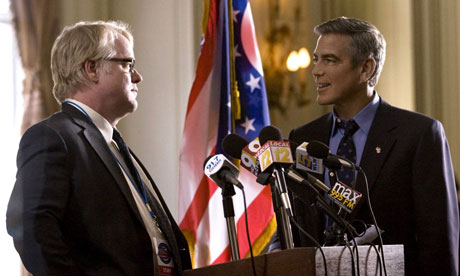
“The Ides of March,” the fourth film directed by George Clooney, is the perfect film for all of us cynics out there. Some might be turned off by the film’s dark tone, but it is the touch of realism that Hollywood fairy tales about politics so desperately needed.
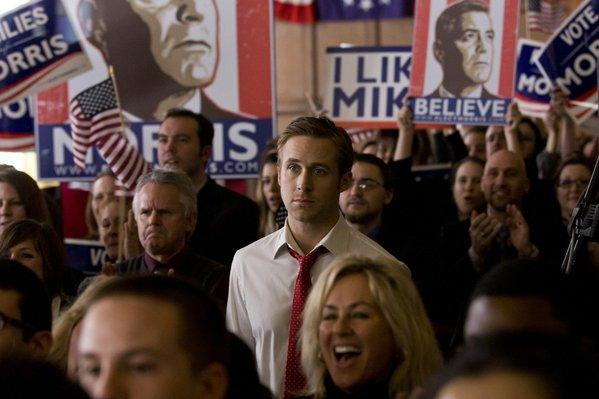
At the beginning, the optimist will feel like Stephen Meyers (Ryan Gosling), the young and ambitious junior campaign manager for presidential candidate Mike Morris (Clooney). Meyers is highly admired and sought after for his skills. It may be less because it is talented and more because he is clueless.
Morris, an obvious allusion to our current president, runs on a campaign of hope and change. His speaking ability and intelligence seem too good to be true. No candidate is good without a loyal team behind them.
Things are going well for the Morris campaign as they make their way through the Ohio primary. Morris looks like the candidate to beat, and Meyers get more and more acclaim from his peers. But after Stephen is approached by the rival candidate’s campaign manager (Paul Giamatti) things go down hill. This, topped with the discovery of a shocking scandal, throws the whole campaign into chaos.
“The Ides of March” made me think back to a quote from one of cinema’s shadiest politicians, Harvey Dent, in which he claims, “you either die a hero or live long enough to see yourself become the villain.” The dehumanizing process of politics has been touched upon in movies time and time again, but in “The Ides of March,” there is no white knight, only a bunch that are stuck in the gray areas of life. As a viewer, you grow to like every character, and then you grow to hate them. By the end, none of them even look like good guys or bad guys anymore. This is a tale of the most twisted morality possible.
While Morris is the film’s central character, his physical presence is sparse throughout. He is like this film’s Gatsby, as our view on him is shaped more by the perceptions of others than by his actual presence. And when we do see him, Clooney plays him more as a blank slate who can easily be swayed in either direction. His views are called idealistic for a reason. By the time a campaign ends and an election starts, a candidate is no longer a reflection of their views but rather of everything they need to win.
Despite the importance of the candidate, Gosling ends up stealing the show as the naive Stephen Meyers. Gosling has been getting better by the movie, and this role should earn him his second Oscar nomination. He has developed a talent for playing characters with a kind and almost innocent outer shell, but with very dangerous tendencies. Here, the danger he holds is in in the naivety of his actions, including his fling with an intern (Evan Rachel Wood). By the end, when he his own voice has been reduced by the endless political commentary running through his headphones, he has officially become a victim of politics. That final expression is stoic yet screaming in inescapable pain.
Watching “The Ides of March,” I was reminded of the recent, equally pessimistic films such as “Michael Clayton” and “The Ghost Writer.” Something that “The Ides of March” has is the ability to make the trivial thrilling. A scene in which Morris’s senior campaign manager (Phillip Seymour Hoffman) steps into a car is so thrilling even though the camera remains stationary. We know something bad is going to happen, but we are denied seeing what exactly it will be. Clooney can make a situation go on for longer than it should, and make us want to keep watching it. Much of the movie is like a ticking time bomb that takes its time to go off, just to mess with its victims.
Clooney shows improvement as a director and unlike many actor-directors, he is not just directing for good performances and writing, but rather for the movie as a whole. He really cares about the consequences of where a camera is placed. The lighting emphasizes shadows. One of the most memorable shots in the movie is of Gosling, in silhouette, standing in front of a giant American flag. Behind this flag, a symbol of freedom, what keeps this country free and democratic is a shadowy, corrupt underworld of lies and false intentions.
In trying to make the small things meaningful, the writing turns dull, political jargon into a fast-paced function of the thriller itself. In “The Ides of March,” ideas and meetings are more action-packed than shootouts and car chases.
Republicans may swoon over the movie’s treatment of the Democratic Party, while Democrats will balk. But the great part about this movie is that it is an allegory not on political beliefs but rather on political corruption. At face value, this is a movie about the disappointments of Barack Obama. Deeper down, Morris is a politician who is more like John Edwards; on the outside, he is a friend of the people but truthfully, he is just fending for himself.
The movie takes its title from the day in which Julius Caesar, who’s power was increasing, was assassinated at the heads of the members of the Roman Senate. This accurately describe the heated relationship between Morris and Meyers, as well as the morally hazy intentions of every character in the movie. Nowadays, few people ask the right questions about our political system. “The Ides of March” is provocative enough to do just that.

Movie Review: 50/50

The famous cliché goes: “Laughter is the best medicine.” Humor has always been a way to cope with the inexplicable things that life throws our way. So in their first film together, director Jonathan Levine and writer Will Reiser did the right thing and madetheir cancer dramedy one about living rather than one about dying.


In “50/50,” Adam’s (Joseph Gordon-Levitt) life comes to a standstill after finding out he has a rare form of neural cancer. The needy and slightly neurotic Adam is the kind of person who avoids risk; he’s too afraid to even get his driver’s license. His fear of death paralyzes him, and his dependence on the people closest to him escalates. His go-to person is his best friend Kyle (Seth Rogen), who is not opposed to using Adam’s cancer as a pickup line. There are also the three women in his life: his overbearing mother (Angelica Huston); his girlfriend (Bryce Dallas Howard), who stays with Adam only because she feels obligated; and his young therapist (Anna Kendrick), who probably needs to sort out her own life before she can help others.


“50/50″ isn’t exactly a cancer comedy, or even a comedy about cancer. Rather, it is a comedy about how people deal with something so dire in their lives. It makes no attempts at a cheery tone and doesn’t settle for artificial characters or a soundtrack consisting of Top 40 hits. It is also a romantic comedy of sorts with its storyline of a successfultwentysomething vying for an unlikely love interest; he even has a goofy sidekick and a burdensome mother. But what distinguishes “50/50″ from the norm is that these characters feel drawn from real life and not from the typical Hollywood playbook. They function as actual, affecting parts of Adam’s life rather than caricatures put in simply for laughs.


The reason that “50/50″ feels so personal is because, through the film, Will Reiser has documented his real-life battle against cancer. Diagnosed six years ago, he has been in remission since then. Reiser bases his humor off of everyday awkward situations and pop culture references such as: “You smell like the cast of ‘The View.’” The jokes and observations laced in his script could only come from someone who came out of a situation this bad. The film doesn’t downplay the reality of such a grave situation, and the underlying current of fear and unpredictability feel all too real.


Because Reiser is writing about himself, he rightfully doesn’t pull a sympathy card with Adam. He is, like the other characters in the film, selfish and small-minded at times. Reiser’s unabashed honesty toward his own actions is reflected in Adam’s character and contributes to the sincerity of the movie.

As Adam, whose success as a radio producer comes to a halt following his cancer diagnosis, Gordon-Levitt does a pitch-perfect job of delivering some great deadpan humor and acting both self-assured and scared out of his mind. The scene in which he shaves his head, the film’s poster image, shows him bravely taking this act as a joke. In a later scene, he breaks down. The emotional outburst is more frightening than anything you’d see in a modern horror movie, perhaps because it feels absolutely right at that point in the movie.


In the supporting cast, Rogen shows how much he has matured as an actor. As the habitually loyal Kyle, who cares deeply despite his cynical outlook on life, he is the kind of friend we all wish we could have. Kendrick is another example of a cast member who is getting better and better by the film; no longer just the girl who had that really annoying crying scene in “Up in the Air.” Her character gives off an innocently funny vibe and radiates a warm presence.


Writing and acting tend to drive this kind of comedy, with the director usually taking the backseat. However, Jonathan Levine makes his presence known, and adds something to “50/50″ that few other comedy directors ever could. While someone like Judd Apatow might keep the camera totally still during a long conversation between a group of friends, Levine moves the camera around. The blurred vision of many shots makes these parts of the movie seem more like meditative talks as opposed to witty banter between friends. Reiser writes it like a comedy while Levine directs it like a drama.


In an interview with Movieline.com, Reiser remarked that when he found out that he had cancer, he and real-life good friend Rogen dealt with it through humor. He said it might have just stemmed from the immaturity of his age at the time. But making the absolute best out of a bad situation is a strength that few have. So in that sense, “50/50″ does what movies have the rare power to do: turn mortality into something both life-changing and life-affirming. If you didn’t think an F-bomb laden R-rated comedy could pack an emotional effect, then you just haven’t seen “50/50″ yet.

Check this review out here at The Daily Orange. It is also available in print form…because newspapers still exist.

Movie Review: The Devil’s Double

The most frightening villains are not the ones who are imagined, nor the ones who are merely real, but the ones in which it frightens us that they actually existed. One of these people is Uday Hussein, the most infamous of Saddam’s two sons. Here is a man so frighteningly sadistic that even the man who is hired (or should I say, forced) to be his double can’t do it.

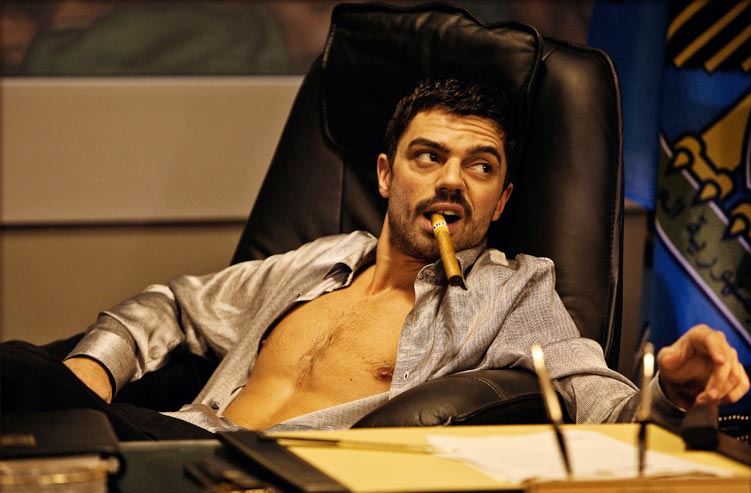
“The Devil’s Double” is the true story of the man who would be Hussein’s body double, Latif Yahia (Dominic Cooper), and how he eventually escaped with one of Uday’s women (Ludivine Sagnier). Yahia went to the same privileged school as Uday (Dominic Cooper, again), and the two were deemed lookalikes by their classmates. After Uday threatens to harm Latif’s family, Latif reluctantly accepts Uday’s offer. It is not the promise of getting everything he wants, but rather the need to save his family, that brings him into this dangerous world. This is the first hint that “The Devil’s Double” is not quite the Iraqi “Scarface” that the television spots make it out to be.
Latif realizes from the moment he is told about the job that being Uday’s double would require him to “extinguish himself.” This is easier said than done, because of the magnitude of change Latif would have to go to in order to transform himself into Uday. Latif is a selfless man from modest means who nearly died for his country. Uday has enough money for a collection of diamond-studded gold watches.
Uday spends his time rounding up as many women as possible, some of age and some not. He lusts, and never desires, any of these women. Collecting women seems less a need to fulfill sexual desire and more a need to show off his power. This comes to light during a horrifying bit when he steals the bride a friend of his had just married.
In a challenging bit that requires him to play two very different people, Cooper steals the show. Then again, there really isn’t anyone to steal the show from. He really steals it from himself. He portrays two very different people not just through the modulation of his voice. He is able to channel both good and evil through his eyes. When looking at Latiff, it is as if an angel exists through his pupils. Uday’s eyes convey someone who is constantly disgruntled and never satisfied with anything besides himself. There is an endless fire burning in his eyes.
“The Devil’s Double” never really bothers to explain or justify Uday’s insane antics. There is a lot to explain, but nothing to justify. As the movie shows, and since we are in the world of film that means what the movie shows is absolute truth, Uday lived a sheltered life. Since his father was Saddam, whatever he want, he got. He could get away with murder, literally.
There are many movies that use a decent person’s perspective in order to portray the mind and madness of a psychotic ruler. “The Last King of Scotland” did this most effectively. The problem in “The Devil’s Double” is that Latif’s story is interesting, but his character is not. Cooper as Uday totally overpowers Cooper as Latif.
“The Devil’s Double” never has a dull moment. It provides an enthralling story from the beginning and never slows down the endless adrenaline that flows through it. Maybe it runs on too much adrenaline, and it tries too hard to make its subject matter mainstream. In this day and age, casting no Iraqis and not allowing the characters to speak in their native tongue. Most of the actors are British and contrary to prior belief, British people and people from Muslim countries are not similar. However, it is a step up from the brown faces that mark the fatal flaw of “Lawrence of Arabia.”
Scenes such as the one where Uday cuts open a man’s stomach, and his organs and his organs are exposed rather graphically, lack clear vision and rely on the weakness of showing everything in order to shock. The beginning, which is devoid of dialogue, intertwined with real footage, and somewhat ambiguous (is that Uday? Or Latif?) is a completely different movie. Uday’s strange relationship with his mother is briefly alluded to, but never brought into fruition. The thoughts that Uday either learned his habits from his father, or was continually trying to anger him, come to mind throughout.
These problems undermine the flashes of brilliance throughout. The scene in which Saddam confronts his son over one of his worst offenses is chilling because of what could have happened.
The film’s weak ending, which comes a few minutes too soon, is a reminder that this is no probe of history but rather an escape action film. It eventually becomes a noteworthy film for its powerful central performance and the uncannily privileged world it brings the audience into. If ever there was a category for this film, “The Devil’s Double” would be called pop history.

Movie Review: The Guard

Brendan Gleeson seems like an easy guy to underestimate. Yet, his snarl can be as furious as his slow yet subtle comic timing. It is this element of surprise that makes him such a vital, unforgettable part of “The Guard.”

In “The Guard,” Gleeson plays Sergeant Gerry Boyle, the only uncorrupt cop in a small Irish town where most of the residents speak Gaelic, pub visits are routine, and murder and drug rings usually aren’t recurrent. That is, until the day Gerry investigates a car crash that leads him to a huge shipment of cocaine into the country. The FBI comes to investigate, and Gerry is teamed up with the more traditional Wendall (Don Cheadle) to break up the drug ring. Wendall comes from a privileged midwestern African American family. Gerry gives off the notion that he’s never been within ten feet of a black person in his life. “I’m Irish. Racism is part of my culture,” Gerry quips. This certainly is not the immediate start of a beautiful friendship.
Make no mistake, “The Guard” is not some social commentary against racism. Ignorance is simply a part of its humor. It’s funny not just because Gerry has such a warped perception of other races, but because he can’t even get his racial stereotypes straight.
Yet, even in his meanest, most unaware moments, Gerry is never a detestable character in the slightest bit. In a position like he is in, his unenlightened views can only hide an immeasurable amount of brains.
“The Guard” works like most comedies today don’t by never dropping a joke. Every punchline, every small scene in a means of leading to another joke later on. You didn’t think those prostitutes were for nothing, did you?
“The Guard” is written and directed by John Michael McDonagh. He is the brother of Martin McDonagh, the theater and screenwriter who made “In Bruges” (which, probably not coincidently, Gleeson also starred in). John took some notes from his brother’s style and incorporates that same pitch black humor, self-awareness, and ambiguity that made “In Bruges” a modern classic. “The Guard” doesn’t exactly reach the life-pondering depth of “Bruges” but it nearly achieves the sly mystery of that film in its ending.
In their efforts, the two brothers have created what can be defined as the Irish lifestyle and humor. The lives of both cops and criminals revolve around the happening of the pub. This is their version of a coffeehouse. That is, a coffeehouse where people can drunkenly embarrass themselves as well as share ideas. Irish men also seem to come with preconceived perceptions of others, as well as street smarts. These traits may be defined both by the rural landscape in which they inhabit, and the unholy amount of Guinness and whiskey that they drink.
Like “Bruges,” “The Guard” ends up being both a fish-out-of-water and a buddy comedy. “The Guard” is a film that rewards those who wait and by the end their partnership isn’t just a means of solving this crime; it has involved into a full-fledged unorthodox friendship. Those are truly the best friends you can find in life: the ones that are nothing like you and yet in those differences, you find something you can hinge on to.
“The Guard” plays as a crime thriller comedy with a straight face almost the whole way through. Unlike say, “Hot Fuzz” this is not a giant sendup on the action movie genre. It seems more of a tribute to how hilarious it can be to step away from all PC boundaries. However, it does go meta for a moment, when a character suggests this story become a movie. Going meta is never a bad touch.
Despite being a comedy, “The Guard” does right in not going for the easy ending. I won’t say what it is, but all I will say is that you are not dumb if you can’t figure it out. Either way that it could go would make sense for completely different reasons. Either way it is definitely life affirming.
When they first meet, Wendall says to Gerry, “I can’t tell if you’re really fucking dumb, or really fucking smart.” Besides the hilarious racism, that’s what makes Gerry so memorable: perhaps he is a little bit of both.
I don’t normally impose upon my readers to see a movie. But this has been a particularly weak summer for movies. If “The Guard” is playing in a theater near you, you’d be really fucking dumb not see it.

Movie Review: 30 Minutes or Less

Who knew that a bunch of perverted, back-stabbing slackers based on the true story that ended in the death of an innocent person could end up being funny?

“30 Minutes or Less” is that movie that asks us to love characters we want to hate. The film never has any trouble “going there” but at a paltry 83 minutes, I can only feel that it reached just half of its potential.
Jesse Eisenberg, plays Nick, perhaps the least likable character in an oeuvre that includes Mark Zuckerberg. Unlike Zuckerberg, Nick has no motivation. He works as a delivery man for a 30 minutes or less pizza restaurant. I’ve never actually seen a 30 minutes or less pizza restaurant in my life, but they did exist in “Dirty Work” and “Spider-Man 2.” In the spirit of those films, Nick can never deliver a pizza on time.
The only person who can stand to be around Nick is his friend Chet (Aziz Ansari), who has advanced slightly farther than Nick has in the world (he is a grade school teacher). Nick is as fast and smart-mouthed as the comedian who plays him, and he likes to be mean to kids. As always, adults making fun of kids is hilarious.
On the other side of the slacker spectrum are Dwayne (Danny McBride) and Travis (Nick Swardson). Dwayne is delusional and psychotic. His view towards women cannot be redeemed by any form of charm. Travis, the more rational of the two, has a slight intelligence that is totally masked by his slow wit. The two of them seem to believe they are characters from “Die Hard,” all while doing unspeakable things to a 3D television.
Dwayne’s father (Fred Ward), a former army major, just wants Dwayne to get out of the house. Conversly, Dwayne just wants him to die so he can have his fortune. So, he hires a hitman (Michael Pena) to kill his father. In order to get the $100,000 necessary to hire the hitman, he kidnaps Nick, straps a bomb to his chest, and forces him to rob a bank. In a panic, Nick reluctantly turns to Chet for help. Chet is not happy about this. After all, Nick did hook up with his sister.
“30 Minutes or Less” is dirty. It is vulgar mostly in the verbal, rather than visual, sense. Strangely, it never gets overwhelming and it never feels forced. It just sounds like people talking with each other.
The film’s casting choices are basically flawless. All of these actors have basically played these characters before, but that doesn’t mean they still can’t play them well. McBride channels his Kenny Powers charmlessness into something very sinister while Swardson plays off the child-like idiocy that helped him steal the show in “Grandma’s Boy.” Eisenberg is often mistaken for Michael Cera. I never understood this, as Cera’s social awkwardness makes him seem sweet while Eisenberg’s awkwardness makes him seem mentally unstable. It works out perfectly here. Eisenberg and Ansari make a great duo, whether they are robbing a bank or slap fighting.
Most uncomfortable comedy focuses on the hilarity of things totally falling apart. Sometimes, that moment before things totally fall apart is so painful that its funny. “30 Minutes or Less” does the opposite: it puts all of its incompetent characters into situations in which failure seems inevitable, and allows them to succeed. Yes, it makes little sense that they were able to hijack someone’s car without getting caught, but its hilarious that they say “thank you” to the person who’s car they steal.
No matter how much I laughed during “30 Minutes or Less,” I had the continuous feeling that something was missing. Most comedies don’t need a very long running time in order to feel complete. “Duck Soup” clocks in at just 68 minutes. A comedy so short should feel like a manic race to make the audience laugh as much as possible rather than a manic race to wrap the story up. While “30 Minutes or Less” is more the latter than the former, it still left so much out. I would have preferred more emphasis on the buddy comedy aspect of the film as opposed to that whole confrontation with the hitman. This might be a mainstream summer comedy, but they didn’t have to stick to plot structure that strictly. The film acts like the bank robbery and closeness to death changed Nick for the best. While things feel different in the end, it still feels as if he didn’t deserve his maturation.
At first, I felt relieved that in its ending, “30 Minutes or Less” didn’t cheat itself as much as the ending of “Horrible Bosses” did (in terms of solving everything with that navigation system). But the film ends with the attitude that money can solve everything. However, this can’t negate the fact that Nick is still an unlikable loser.
“30 Minutes or Less” wants to be a Coen Brothers caper gone wrong filled with lowlifes mixed with the dirtiness of the typical Apatow comedy. However, Dwayne and Travis’s desperation can’t elicit the pity from pathetic desperation. And while the characters in this film are all fun to watch, they possess no redeeming qualities. Perhaps that is fully intended, but not even Nick’s love for Kate (Dilshad Vadsaria) can redeem him at all.
With an all star cast and a promising young director (Ruben Fleischer’s last feature was “Zombieland”), “30 Minutes or Less” had the potential to be a well above average comedy during the summer doldrums. In the end, it turns out to be an average one. It is short, and never too deep. And as Swardson’s Travis would obviously forget to say, “that’s what she said.”
It’s safe to say that Aziz Ansari steals most of the scenes he is in. It would have been nice if they let him throw a few nicknames in though.

The Shawshank Redemption: On Life in Prison and Life in General

Warning: Spoilers Ahead.

Thanks to AMC, which would be the best movie station on TV if not for all the f—ing bleeps, “The Shawshank Redemption” has been playing nearly every week this summer. Despite being the banner image of this blog for well over a year, “The Shawshank Redemption” has not gotten its moment in the sun here. It’s time for that to change.
“The Shawshank Redemption” has earned its place among cinema’s finest. That’s a huge feat for a movie that was critically and commercially shunned upon initial release. Today, it is famously ranked as the greatest movie of all time on IMDB’s Top 250; just one notch below “The Godfather.” The legacy of “Shawshank” has increased over the years. That is in large part because of its emotional impact. This is one of the few movies that could make a grown man cry. You might get teary eyed from Brooks’s final monologue. Or, perhaps it will hit you after that last shot, as the gentle Pacific and the endless stretch of beach frames two friends reuniting for the first time, finally free. That’s the one that always gets me.
Much of the film’s emotion comes from Frank Darabont’s incredibly human direction. He lives by the rule that what can’t be seen is more powerful than everything we do see. During the aforementioned scene in which Brooks says his final goodbye to the world, the camera makes his suicide all the more devastating. We never actually see him hang himself, but instead we see the pieces of wood coming off the wall as he writes “Brooks is Here,” and finally we see his the table fall from under him as his feet shake, and then remain in a still, and eerily peaceful, state.
“Shawshank” is a film that carries strong ethos to match its pathos. Its story of a corrupt prison is as much about a corrupt prison as it is about corrupt society as a whole, and how the human mind and soul fit in.
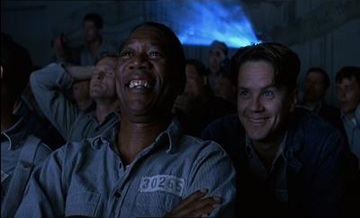
Before we get into that, let’s start from the beginning. Andy Dufresne (Tim Robbins) is a banker sentenced to life in prison after his adulterous wife is found dead, and he is found guilty of the murder., despite his claim of innocence. Dufresne is a quiet man, and this makes people misinterpret him as a cold man with no remorse. Really, his silence hides an intelligence far beyond most others. Andy is sent to the corrupt Shawshank Prison, where forms a friendship with Red (Morgan Freeman) during his two decade imprisonment. Red tells Andy that he is “the only guilty man in Shawshank.”
It seems customary at this point that every film about a life of imprisonment must have a lead character who doesn’t belong. In “One Flew Over the Cuckoo’s Nest,” R.P. (Jack Nicholson) wasn’t actually insane (like most of the other men at the hospital). And while Luke from “Cool Hand Luke” actually did commit a crime, he has a spirit too big for the hellish southern prison he’s been placed in. Perhaps it is through all of these eccentric characters that we see that these institutions offer punishment, but no rehabilitation, for any of the people that are sent to them.
In “Shawshank,” prison is more than a dehumanizing place. It is an industry, and a world of its own. In this industry though, cigarettes are used as currency.
It makes sense that a place as isolated as prison would become a world of its own. What is so interesting about “Shawshank” is that it mirrors the creation of society. The men are supposed to enter from the real world with something of a blank slate, as they are expected to eventually feel guilt and want to change as a result of their prison sentences. There are many ways to “save” men. The Warden (Bob Gunton) believes salvation is found through Jesus Christ. Every man who wants to follow this path seems to do it just as a cover up for wrongdoing. Then, there is Andy’s way of thinking. During the scene in which he plays Mozart over the loud speaker, he is exposing the deprived prisoners to culture. None of the prisoners understand what the woman is saying in the song, but they know that it is moving. There is a sort of universal language that runs through every work of art, a kind of language that those obsessed with power are too blind to understand. Andy is not a machine, he is a record player: he has the cheerful, care-free flow of great music constantly flowing through him.
In these respects, “Shawshank” is about the relationship between the powerful and the powerless. Darabount uses this idea to give, well, sympathy to some people who don’t really deserve it. The scene in which Bogs (Mark Rolston), Andy’s tormentor, gets what is coming to him ends up being more painful than cathartic. That is because Bogs is literally dragged into his own cell by the ruthless Captain Hadley (Clancy Brown). Even if someone is bad, once they become helpless, you immediately feel for them. This is a case of “A Clockwork Orange” Syndrome: no fight is fair if both sides cannot stand up for themselves. It is someone’s right to choose whether they want to defend themselves. Once that right is taken away, that man ceases to truly live.
And that is what the redemption of “The Shawshank Redemption” truly is: gaining freedom. It is not just the freedom to return to the outside world. The outside world is a place that “got itself in a big damn hurry.” It is about achieving inner freedom: the freedom to explore, learn, and make decisions for oneself.
“The Shawshank Redemption” is many more things that a few more viewings might help me find. It uses religion as a way to raise its hero into savior status, all while showing the ways that religion can be linked to the triumph of evil. It is a brilliant choice of letting Red, rather than Andy, narrate the story. This is not just because Morgan Freeman is the only person who could emulate what God would probably sound like, but because it adds a narrative complexity. Andy is a mystery. So is his overall escape mission. If the film were told from Andy’s perspective, the mystery would be gone. Andy also doesn’t quite seem to understand why he is so unique. Only an outsider could explain why. Another brilliant narrative technique? The fact that the clothing worn by three different women (Rita Hayworth, Marilyn Monroe, Raquel Welch) marks the passage of time in the film.
I don’t take much credence in the IMDB Top 250, but the fact that “The Shawshank Redemption” tops the list gives me some faith in it. Even if it isn’t the greatest film of all time, this top spot shows that the next generation that will control the movies, and the common opinion of movies, actually has some good taste. Perhaps, “The Shawshank Redemption” will one day be considered as timeless as “Casablanca” and “Citizen Kane.” I don’t think anyone would really mind.