Category Archives: Movie Review

Movie Review: Hot Tub Time Machine

In his review of “Shutter Island,” the New Yorker’s Anthony Lane drew upon a quote from Umberto Eco: “Two cliches make us laugh but a hundred cliches move us, because we sense dimly that the cliches are talking among themselves, celebrating a reunion.” Lane was using this to describe a totally different movie, but I think it fits even more perfectly into “Hot Tub Time Machine.”

“Hot Tub Time Machine” is the 1980s comedy made for 2010, both stylistically and literally. It begins in the modern day. The film’s anti-heros, three best friends who’ve hit some rocky times, are typical everyday schlubs. Adam (John Cusack) has to deal with both a recent breakup and his reclusive nephew (Clark Duke) who lives with him. Nick (Craig Robinson) is a burnt out musician, and Lou (Rob Corddry) is an alcoholic who has just hit rock bottom.
Well, the first half of the premise probably made this movie sound a little too serious. Just wait until you hear the next part. The four head up to a now decrepit ski resort to try and relive their glory days. After a night of too much to drink, the boys’ hot tub sends them back to the 1980s. There, they relive all the greatest moments of their life, and those they tried to totally forget about.
“Hot Tub Time Machine” can be described as a different kind of nostalgia. It’s a nostalgic tone that’s both a little mocking, and a little reminiscent. Unlike some other previous homage films such as “Black Dynamite,” “Hot Tub Time Machine” wouldn’t totally fit in as a film in the 1980s. It does contain everything we love about an 80s classic, but with the wisdom of someone living in the year 2010.
However, this isn’t to say that “Hot Tub Time Machine” doesn’t evoke its era well. When it does go back in time, it does everything it can to put you into the year 1986 from the music people listened to, to the kind of shoes they wore. Then, it crams in about a million different 80s movie cliches. There’s the upper class bully, the losing-your-virginity story, and of course, some anti-Communist paranoia. “Red Dawn” style.
It really does feel like all of these different cliches are having a reunion together. It could be that the writers, director, and actors were actually having a fun time with it all, or that this era of filmmaking had a little more depth than ever imagined. Maybe this was just an era where people were making films about the world they wished they lived in, rather than what it actually was.
Even for a film that’s unapologetically dirty (consider this a warning), there is still something very smart behind its stupidity. The film’s humor is a mix of gross out and tongue-in-cheek.
Perhaps the one moment in the film that could actually be described as brilliant comes after the characters have been transferred back to the 80s. Robinson remarks, “must be a…hot tub time machine.” Then he just stares at the camera. Not only have the filmmakers broken the fourth wall, but they’ve also managed to make fun of how films try to incorporate their titles into their dialogue while at the same time creating one of the best title tie-ins I’ve seen in a movie.
“Hot Tub Time Machine” would definitely have been a failure had it not been for a cast and crew who actually knows their way around the subject. I would like to point out that co-writer Sean Anders, who also wrote the awful “Sex Drive,” manages to succeed here by actually putting funny words on a page.
I think the cast really helped make the film even better. You can feel that they took control and made it their film as well. Corddry finally got the breakout role he deserved, and he’s certainly gotten the a-hole personality down well. Robinson always incorporates his smooth talking, but sometimes very angry, personality and turns it into laughs.
Then, of course, there’s Cusack. Here, Cusack seems to play a bit more of a demented version of Lloyd Dobler and any other romantic he played during the 80s. There’s something about his personality that is so endearing. Maybe it’s that he never seems happy yet he’s never a killjoy. I think it might be a little closer to his performance than “Better Off Dead” than in “Say Anything…” What I really want to say here is that I hope Cusack takes more roles like “Hot Tub Time Machine” and less like “2012.”
There is one thing I’ve thought about complaining about in “Hot Tub Time Machine.” However, I can’t bring myself to because it actually works here. That one thing is how much the premise resembles “The Hangover.” It’s also about the result of a night of debauchery and contains the same archetypal characters. But as long as this premise keeps working, I will keep seeing movies just like it. This premise might one day become the cliche to define the 2000s.
“Hot Tub Time Machine” broke the fourth wall in more ways than mentioned before. The sum of the film and its characters is not just homage to the films of the 80s, but rather both the characters and the filmmakers looking back at what that era meant. It fits the style of the 80s into the style of the present. Oh, and most importantly, it’s just the kind of film that you see, laugh at, and then keep laughing at long after it ends.
80s Movies That Likely Inspired Hot Tub Time Machine: Back to the Future, Bill and Ted’s Excellent Adventure, One Crazy Summer, The Breakfast Club, Say Anything…, Red Dawn, Sixteen Candles, Better Off Dead, Weird Science, Encino Man (Not 80s, but close enough)

Movie Review: The Ghost Writer

During the preceding months, much of the buzz about Roman Polanski has been focused more on his twisted personal life, rather than his twisted new film, “The Ghost Writer.”

“The Ghost Writer” combines contemporary political intrigue with the two things Polanski does best: mysterious thriller, and the utter darkness that humanity is capable of. It begins with a struggling British writer (Ewan McGregor). He’s never given a name, he’s simply referred to as “The Ghost.” It’s fitting, as his character seems more like a spirit than an actual human beings to the rest of the characters.
Anyway, McGregor’s writer accepts a high paying job to be a ghost writer on the memoirs of former British Prime Minister Adam Lang (Pierce Brosnan). Lang is forced to live in the United States after being convicted of war crimes for ordering the torture of several terror suspects. The Ghost is brought in after Lang’s previous ghost writer is found dead on the beach. As The Ghost finds out more about Lang’s strange life and personality, he unravels a shocking and dangerous mystery.
“The Ghost Writer” comes out at the heals of another fascinating psychological thriller from a legendary director: “Shutter Island.” “The Ghost Writer,” however, is one that exists much more in reality. Yet, they both deal with characters we would’ve seen in films by these directors during their finest hours. The Ghost is the typical Polanski lead: he is the good guy who tries to do good in a world filled with wrong. However, his good intentions always go awry.
Polanski is the rare director who fully incorporates both his life experience and world views into his work. Over 40 years on, and he is still capable of producing some of the darkest visions that will ever hit your local cinema.
“The Ghost Writer” is raised up by a trifecta of brilliant male leads. McGregor not only plays The Ghost, but he transforms himself into a true ghost of a man. He never seems content with his situation as he quite simply floats through life. He always contains the restless, red-eyed look of a disheveled insomniac.
Meanwhile, two of the films character whom can be classified as villains fit into the Polanski category of the “genial villain”: that bad guy who hides their evil under a mask of false kindness. In just a few scenes, Brosnan stole the show and totally erased his Bond image. You may be tricked by his humor and good personality, but he never lets you forget why he’s on trial in the first place.
The other scene stealer is the always dependable Tom Wilkinson. He also has a talent for obscuring what may be bad intentions. The scenes in which The Ghost converses with Lang and Paul Emmett (Wilkinson) gave me a strong vibe of Polanski’s masterpiece “Chinatown,” specifically the scene where Jake questions Noah Cross. In that scene, we all know Cross is a guilty, despicable human being; but Polanski chooses not to show him behave that way. In this way, both Wilkinson and Brosnon channel John Huston fully. It also brings out Polanski’s theme that most times, evil prevails because evil can disguise itself.
Despite the great performances, this is entirely Polanski’s film. He turns what could’ve been a trashy thriller into intriguing film noir. The mystery is great because we never give up on it, we want to know what the answer is up to the film’s very final frame.
Polanski’s voice is ever present. He uses both sight and sound perfectly to emphasize mood. Dark shadows mixed with a creepy score heighten the mystery, while the film’s often oddly cheery musical beats will mislead you into thinking things might just be going right for once. Don’t believe that. The film also takes full advantage of the camera, as it heightens tension with the use of longshots. The longshot is key turning an edge-of-your-seat chase scene as well as one pivotal scene at the film’s end.
“The Ghost Writer” is one of those films that doesn’t leave you after you’ve finished it. You’ll talk about the twist, and you’ll likely talk about the modern political worldview the film opens up. You’ll see that things just might work in ways you never even imagined.
After this film was released, many have been harsh toward it because of Polanski’s personal struggles with the law. While his actions in real life may be deplorable, they must remain separate from the artist. Art should not be judged on morality. However, it does seem to be that personal conflict is often what inspires people most in their art. Polanski’s dark films are likely inspired from the unimaginably dark events that have shaped his life. Perhaps without this struggle, without this intrigue, without Polanski, “The Ghost Writer” would not have been the great film that it truly is.

Movie Review: Badlands

“Badlands” just proved the impossible to me: an epic story can be told in under two hours. In fact, all you really need is 90 minutes. It may just be that Terrence Malick is one of the best, and definitely the briefest, epic storyteller.

“Badlands” is a story that’s been done time and time again. Yet, Malick takes it and tells it in the most gripping, original way possible. “Badlands” begins in a quaint South Dakota suburb. It’s told from the point of view of Holly (Sissy Spacek), a bored fifteen-year-old with an overbearing and abusive father. She forms a relationship with Kit (Martin Sheen), a rebellious garbageman with the look and attitude of James Dean. Kit “saves” Holly from her sheltered life and they live a slightly nomadic life on the road. They leave a bloody trail up to the Badlands of South Dakota.
“Badlands” came out just six years after the revolutionary “Bonnie & Clyde.” I bring this up simply because the story of Kit and Holly nearly matches the story of Bonnie and Clyde. Though in a way, “Badlands” might just be a better movie because their escape feels so much more painstakingly built up to. Not to mention, their crimes are even more inexplicable and therefore even more horrifying.
The greatness of “Badlands” can be attributed to the culmination of so many different things. It is not merely an achievement in one field. First off, there’s the fine performance by the then unknown, but now legendary stars. Sheen so perfectly emulates James Dean, the one man his character constantly seems to try to emulate. Spacek meanwhile, is so convincing in her innocence that even after all Holly has been through, we realize she is nothing more than a confused and misguided teenager.
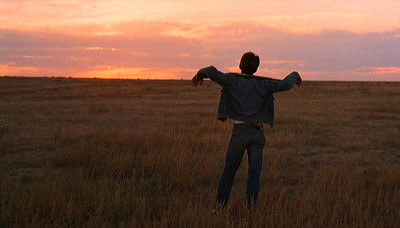
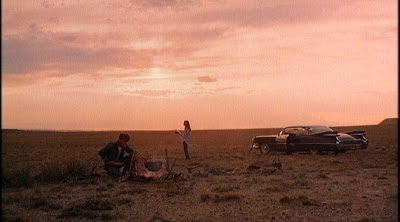
Despite the fact that nearly everything in the movie achieves for the satisfying whole, “Badlands” is overall a triumph in cinematography and directing. The images at times feel less like film and more like still photos. They are jaw dropping in their scope. It’s amazing how the film is able to turn nature into a living, changing character. We get to see the sky turn from day to dusk to light.
Of course, not of that would be possible without Malick. Malick is a known recluse who only directs a film every 20 years or so. That’s a shame. He has created possibly one of the most beautifully shot films I’ve ever seen. It’s not just what’s in the images, but how much detail is put in every shot that astonishes me so much. Sometimes, it seems like nature is more important to Malick than the actual story. Look closely at how Malick makes the tall, brown grass looks golden. And watch how the gold contrasts to the lush green right behind it.
Look at other times how the characters are framed against the ever expanding desert, or the gorgeous sun at dusk. These are our characters: as wild and curious as the world that surrounds them. Nature is our characters. Our characters are nature. It’s not just the fact that the images are beautifully shot, but that they feel so real. Everything about “Badlands” just feels absolutely organic.
What I feel is so impressive about Malick’s direction is not just the images he shows, but how he strings all of that together into a story. Some films linger on their beautiful images and forget to tell their stories. Malick doesn’t forget his. He manages to both tell a compelling story and take extended breaks to admire the scenery without running on forever. It’s epic filmmaking without an annoyingly long epic running time. I’d also like to add that the film’s climax includes one of the best chase scenes never talked about in cinema. It’s eerily personal, and so effective in how it manages to create sympathy for a character who really doesn’t deserve it.
“Badlands” has an influence that extends well into today’s world of film. I can see its visual influence in filmmakers like the Coen Brothers, Sam Mendes, and Gus Van Sant. It has imagery that will forever haunt and stun me. The story of Kit and Holly being blinded by false ideas of freedom and rebellion is like the ultimate American ballad. And Mallick is not just its auteur, but its poet.
If You Liked This Movie, You’ll Also Like: Bonnie & Clyde, My Own Private Idaho, Natural Born Killers, Mean Streets, Barry Lyndon, American Beauty, Away We Go, No Country for Old Men

Movie Review: Alice in Wonderland

This is not the Alice you were expecting. Or so we are reminded throughout. This is a new Alice, in a new Wonderland, for better, or for worse.

Tim Burton’s “Alice in Wonderland” gives you exactly what you’d expect in a Tim Burton film: weirdness, darkness, and madness. Although it misses out on some of the depth of his earlier work, “Alice” shows that this man still understands the concept of the fairytale.
Rather than making this “Alice” exactly like the original, Burton decided to give it a little twist. Thirteen years after first discovering Wonderland, Alice (Mia Wasikowska) is curious teen, totally loathing her dull Victorian lifestyle. As she is proposed to, she follows that same white rabbit with the stop watch and falls down that same rabbit hole. She’s back where she’s been before but this time, she can’t remember a thing.
While in Wonderland, she meets the very mad Mad Hatter (Johnny Depp), who convinces her to team up with the White Queen (Anne Hathaway) and defeat the evil, reigning Red Queen (Helena Bonham Carter) by slaying the Jabberwocky.
To this minute, I still feel split in my thoughts on this film. On the one hand, it was thoroughly entertaining. On the other hand, it’s filled with flaws.
My biggest problem with “Alice” was that it felt as if Burton was rushing through the story. Even though Alice has existed for almost 150 years, this is obviously a different Alice than we’ve seen before. It’s apparent that she’s a bored free spirit living in the wrong universe. However, barely any background is given as to how she became this way. I thought one of the stronger aspects of “Where the Wild Things Are” (a film I use as a basis of comparison because they are actually very similar) was that it built up all of Max’s anger and alienation into this alternate world. He earned his rite of passage into the Land of the Wild Things. Alice should’ve waited a bit longer.
“Alice in Wonderland” is perhaps the most ambitious experiment in converting a film into 3D. However, this story should’ve been kept in the second dimension. None of the visuals seem to pop out at you in an “Avatar” way. Seriously, that 3D cat food commercial that ran before the movie started used the technology better. A film that isn’t shot in 3D isn’t shot in 3D for a reason. Burton was probably trying to keep his vision two dimensional on purpose.
Despite the failed 3D, the set design and cinematography are nothing short of stunning. Burton creates a world that’s been seen so many times before in a surprisingly unique way. He tries to turn Wonderland into his own land. Meanwhile, the lush yet dark photography perfectly matches the film’s tone.
Rather than going with a known lead to play Alice, Burton went for newcomer Wasikowska. She’s a welcome breath of fresh air, and certainly a promising future star. She takes a 19th century character and fills her with relatable, 21st century teenage angst. It’s too bad she wasn’t given a better script, though. Same goes for Depp. Based on interviews, it’s obvious how much amazing work Depp did to portray the Mad Hatter. However, he’s given such little time to do his thing. I think with a little less constraint, Depp could’ve done the same thing with the Mad Hatter that he did with Jack Sparrow in “Pirates of the Caribbean” and Hunter Thompson in “Fear and Loathing in Las Vegas.”
I think what this is all leading up to is an unfortunate amount of superficiality. That’s disappointing for a director who’s brought humanity to both a man with scissors for hands (“Edward Scissorhands”) and the guy who directed “Plan 9 from Outer Space” (“Ed Wood”). Burton has always put much effort into the world he creates, but he never abandons the humans that inhabit it. And even here, Burton doesn’t seem to relish the wonders that Wonderland provide. You stare, but don’t gaze, at it.
I hope I’m not sounding too negative because overall, “Alice in Wonderland” is a good film, but just not the great one that it could’ve been. “Alice in Wonderland” might give us a new story, and a new Alice, but something about it just doesn’t seem inspired enough.

Movie Review: Black Dynamite

Something very interesting happened while I was watching “Black Dynamite.” For about an hour, I understood what it was getting at, and what it was trying to do. At that, it was doing well. What I couldn’t help but wonder was: where’s the big punchline?

Then, it came. And then I saw that “Black Dynamite” was not just an homage, nor was it a product, it was a twisted, brilliant little movie of its own.
“Black Dynamite,” a film released last year, is a throwback to the ever influential Blaxploitation genre of the 1970s. As the name suggests, it was a genre that exploited black stereotypes (as well as violence) for the sake of entertainment. In the latest addition, Black Dynamite (Michael Jai White) is a former CIA agent who knows Kung Fu.
After his brother, an undercover agent, is murdered in a drug deal gone wrong, Black Dynamite gets his license to kill back and seeks revenge. In the process, he cleans the streets of drugs and uncovers, a deep, and possibly very lethal, conspiracy.
“Black Dynamite” is more than just an homage to Blaxploitation cinema, it is Blaxploitation. This movie could’ve been released amongst films like “Shaft” and “Foxy Brown” and blended in just fine. It transports us back to a simpler time, when it was still acceptable to call a white person “honky.”
Before I go further, I will admit that I’m only loosely familiar with Blaxploitation films. I know more about them through reputation than actual viewing. Having said that, “Black Dynamite” could capture more than a genre; it even captures an entire era. While watching it, I felt reminded of the underrated “Grindhouse.” Both are films that could easily fit into their eras as they both mimic the little things of the films they emulate such as the lighting and even the sound effects.
On that note, “Black Dynamite” has a score that sounds like the great, smooth Funk of Isaac Hayes. That warm glow of the light makes for a light-hearted, utterly entertaining work of film. Meanwhile, the often grainy, documentary-like cinematography, was common in shoe string budget exploitation films.
Now, as I mentioned earlier, lets talk about that little turning point. “Black Dynamite” goes from purposefully silly exploitation to a sort of over-the-top ridiculousness that becomes almost sublime in a scene where Black Dynamite and his men figure a conspiracy out. In one way, it’s mocking ridiculous explanations for twists in films (I’ll never look at the white board scene in “Shutter Island” the same again). In another way, it hops from one point to another in such a form that only someone with a knowledge of film both great and bad could ever come up with. You’ll be astounded not at the fact that you couldn’t come up with it, but that anyone could ever think of something like this in the first place.
I would definitely credit much of the film’s success to Scott Sanders’ 70s style direction. But much credit should be given to the screenplay, which is co-written by star Jai White. It remains totally in the era and manages to make several running jokes (such as the repeated use of the phrase “jive turkey”) fresh throughout. Despite the film’s extremely short running time, it still manages to get most of what it sets out accomplished. There were a few strands, like a corrupt congressman character, that remained somewhat unsolved at the end. Then again, this is a tribute to imperfect cinema.
“Black Dynamite” is the kind of film I could see myself watching several times and not tiring of it. In its goal of not only evoking a past era, but becoming a part of it, it succeeds admirably. Oh, and I forgot to mention that odd yet almost audacious thing it does with a certain former President of the United States. Guess you’ll just have to find that out for yourselves.

Movie Review: Shutter Island

Sometimes, the language of film, and the language of literature, just fit together like a puzzle. When I think of great directors and great writers with similar visions, I usually just think of the Coen Brothers and Cormac McCarthy over “No Country for Old Men.” Now, I can add Martin Scorsese and Dennis Lehane, over “Shutter Island.”

In novel form, “Shutter Island” was a crackling and suspenseful psychological mystery that never took the obvious route. As a film, it is both a psychological thriller and an ode to a genre that seemed to have died ages ago. “Shutter Island” is set in the year 1954. Miles off the coast of Boston, there is a place called Shutter Island. It houses a mental institution for the criminally insane. The most dangerous patient, Rachel Salondo, has somehow escaped. U.S. Marshall Teddy Daniels (Leonardo DiCaprio) and his partner Chuck Aule (Mark Ruffalo) have been assigned to crack the case.
Before going on there are a few character points, rather than plot points, that need to be explained. Teddy is a war hero, haunted by what he saw when liberating Dachau. His wife (Michelle Williams) recently died in a fire. So yeah, this guy has problems. Meanwhile, Salondo murdered her children.
Over the years, Scorsese’s directorial skill has been put into question. Yes, he’s made a few flawed pictures (“Gangs of New York,” “The Aviator”), but even those are more watchable than most of the films that come out today. Truth is, most of his recent stories do not even come close to his old ones. However, could anyone ever make a film as good as “Taxi Driver” or “Raging Bull” ever again?
“Shutter Island” clicked for me because I feel it has something for everyone: a little bit of entertainment and a little bit of depth. It’s the kind of film that you walk out of wanting to talk to someone about the ending. It’s also the kind of film where you know, in the end, your money has been well spent.
“Shutter Island” shows that Scorsese, more than ever, knows how to work a camera. Not only that, but turn it into a form of art. Here, he brings back the long shots he used so masterfully in “Goodfellas” and does a few other camera techniques that bring out the ever growing sense of chaos.
This also shows how Scorsese is one of those rare directors who make movies with the self-awareness of being a movie, and being so inspired by movies of the past. The dark, smoke-filmed rooms totally bring out the film noir of the 1940s and 50s. I originally thought the music was somewhat overdramatic but when I think about it, I think it is meant to evoke the somewhat over-the-top nature of old thrillers.
Also, there is a very poor green screen in the backgrounds of some shots. It may evoke the Golden Days of Hollywood. However, it may also evoke some things about the character which I will not spoil for you. But only a director like Scorsese could use something so faulty and make them inspired and ironic.
Along with Scorsese’s direction, the acting was also fantastic. DiCaprio is truly proving himself to be a great leading man now. He corresponds well with Scorsese’s direction by constantly bringing out the trembling darkness within Teddy.
Also scoring a great performance by Ben Kingsley as the head doctor. I think it’s his line delivery that did it for me. The way he says, “it’s like she evaporated, straight through the walls,” is one that sounds both entirely innocent and oddly disturbing.
Back to Scorsese for a minute, because he is truly what makes this movie for a work. I want to use one specific scene to show his great direction. In one scene, Teddy is climbing down a steep, rocky cliff. We know the hero can’t die this early, but Scorsese puts a big, fat question mark to that possibility. He shoots this scene from very tight, claustrophobic angles and we feel like we’re there with him, climbing down those rocks. He takes a scene that might have made the viewer feel nothing, and packs it with suspense.
I believe the story goes from page to screen so well because Scorsese takes Lehane’s story and themes and makes them into his own style. Through the characters of Teddy and Rachel Solando, Lehane finds characters searching for redemption and trying to come to terms with their pasts, and their selves. Teddy’s own struggle with the horrors of war he’s seen could mirror what Travis Bickle had to live with in “Taxi Driver.” Through this, we can understand the character of “Shutter Island” even better.
The story of the film of “Shutter Island” isn’t much different than it was in the book. However, the fact that Scorsese can take Lehane’s style and mold it into his own is what makes this a truly faithful, truly successful adaptation. Scorsese takes Lehane’s dark message about human nature, and turns it into a haunting (and even relevant) message about how today’s world works.
Of course, there is quite a surprise of an ending. Even for somebody who read the book and knew the ending, I was still surprised when the big moment came. Scorsese masterfully knew how to both hide the truth and even make it seem very apparent at other times.
The more I think about “Shutter Island,” the more I like it. Scorsese has truly made a movie for everyone: it’s both simply entertaining, and complexly thought provoking. Quite simply, it is the ultimate experience for those who love movies.

Movie Review: Fish Tank

Mia is always running. You would to if you lived a life like her’s. Her life is hard. That might sound vague, but her plight is emphasized in almost unbearably vivid detail in “Fish Tank.”

“Fish Tank” is the next chapter in what I consider a British New Wave. Along with last year’s “In the Loop,” “An Education,” and “Moon” as well as 2008′s “In Bruges,” “Fish Tank” is part of a series of incredibly well crafted (and entertaining) British films.
Of all these films, “Fish Tank” might just be the darkest. It is a gritty look at lower class life. With its shaky camera, “Fish Tank” at times feels like a documentary. The film follows the life of Mia (Katie Jarvis). Mia is a 15-year-old living on the outskirts of London with a tendency to get in trouble. On the outside, she’s tough and reckless. On the inside, she’s vulnerable and dreams of being a dancer.
Any hope Mia might have is crushed by her physically abusive and unloving mother. Her mother’s new boyfriend, Connor (Michael Fassbender), is kind and caring. Mia soon falls in love with him, and begins a doomed affair with him.
“Fish Tank” introduces its audience to a world it is likely not at all familiar with it. By the end, you’ll feel like you lived it. As mentioned, the constantly shaking camera makes the film feel like a documentary. When Mia sits, the camera sits. When Mia runs, it runs with her, shaking all the way, as if someone is directly following her every step.
The film’s cinematography is just one thing to show that this film is alive. Not to mention, the constantly changing colors brilliantly match each shot and never get in the way of the story (this was a big problem for me in “A Single Man”). Then there is the music. The rap songs help make this film the most vibrant and energetic social drama I’ve seen since “Do the Right Thing.”
It is amazing to say that I’m saying that a film like “Fish Tank,” full of emotionally devastating abuse, could also be classified as energetic. It is a testament to the power of Mia, that she can still bring life and energy into such horrible circumstances.
Speaking of Mia, she’s an interesting character to talk about. She reminds me in a way of a young, more destitute Madame Bovary for the 21st century. She seems to base her life in the idea of fantasy so much that she blends fantasy and reality. This can be seen in her affair with Connor. She might think she’s finding true love, but actually, in a twisted way, she’s really searching for a father figure in her life. Or maybe she just needs an intelligent and caring male to counteract the poor female role model in her life.
Newcomer Katie Jarvis is electrifying in her debut performance. She has no problem going down to the hardboiled truth of Mia’s character. I was also thoroughly impressed by Michael Fassbender. Fassbender wowed me in his brief performance in “Inglourious Basterds” and in “Fish Tank” he brings that same tough yet relaxed geniality to make Connor a character who is hard to hate. Fassbender is blossoming into something of a great actor, and I’m expecting much from him in the years to come.
“Fish Tank” is a great movie because it takes a good story and uses a distinct directorial style to make it great. Director Andrea Arnold has a love of the surrounding world. She’ll often focus on different objects around a room to directly reveal character.
Arnold also focuses heavily on the surroundings, like a giant wind turbine that lies right outside her apartment. It creates a direct contrast between two very different worlds within such close distance. Then there is the film’s beautiful last image. I won’t give it away, but I will say is that it nearly encapsulates the entire film in just one shot. Even in a film that seems to deny the idea that people can live out their wildest fantasies, this one shot shows that in a hard world love still exists if you actually try and find it. The title itself, meanwhile, shows how everyone is trapped into their own personal fish tank of an existence. Only the strongest can swim away.
Even though it’s only February, “Fish Tank” is the first great film to be released in 2010, and one that will most definitely be a top 10 contender come December.

Movie Review: Moon

Of all the movies I’ve seen, even the strangest still give me something to say. It is at the rarest occasion that I am almost at a loss for words. One of these rare occasions occurred as I watched Duncan Jones’ “Moon.”

This doesn’t at all mean that “Moon” is a bad movie; it is in fact quite a good one. It is just so complex and almost non-linear that it will take a lot to explain what I just saw.
The film is a mixture of both the sci-fi and psychological thriller genres. Along with “District 9″ and “Avatar,” “Moon” proves why 2009 was the year that sci-fi made a comeback.
“Moon” is set sometime in the near future. At this point, humans have gone beyond using dirty forms of energy and have found a clean form of energy in fusion from the sun. This form of energy can only be found on the surface of the moon so the company Lunar Industries sends people to the moon to harvest it.
At the moment, the man on the moon is Sam Bell (Sam Rockwell). Sam is under a three year contract and, being the only person on the moon, faces extreme loneliness. He especially misses his wife (Dominique McElligott) and daughter. The only company he has is a robot named GERTY (Kevin Spacey). The only thing that makes GERTY seem remotely human is the little smiley face attached to him, which at times seems more intimidating than friendly.
One day, Sam is involved in a vehicle crash and wakes up to find himself in the middle of Lunar’s twisted, new experiment.
It’s going to be hard to discuss both the thematic and narrative implications of “Moon” without giving away a giant spoiler. Therefore, I will do my best to avoid revealing this huge plot point. What I will say though is that Rockwell does an amazing job dealing with this twist. I always knew he had talent, but “Moon” just proves it even further. He shows some great skill handling a character with a tendency toward both lunacy and normalcy. In the face of the very strange journey he goes on, he manages to seem as realistically perplexed as the viewer is.
Jones’ writing and directing also deserves great praise. I am always fascinated by visions of the future. Where do artists believe we are headed as a species? “Moon” definitely has some interesting things to say on that topic. While a lot of dystopian genres take the bad things of present day society and amplify them in the future, Jones does the opposite and takes the clean energy craze and turns it into something that could doom us all.
However, Jones also does tie in the topic of technology. Sam’s isolation could be a tool to show how our increasingly computerized world can be dehumanizing. In fact, the future of “Moon” seems like a time in which humans are treated more like machines that can be easily programmed and deprogrammed then like actual human beings with thoughts and emotions. The future will quite literally be dehumanizing.
“Moon” also manages to create a convincing futuristic hell through the amazing set designs. A lot of the cold, white hallways of the station were reminiscent of “2001: A Space Odyssey.” This isn’t very surprising, as that film also portrays a future where humans have been taken over by technology. Also, the utter attention and focus put on every detail of this time create a world that seems so vividly real that the viewer might almost feel a part of it. That is the true essence of a Kubrickian filmmaker.
The film also felt slightly like “Alien,” as it pits helpless crew members in space against a corporation with shady intentions. “Moon” also uses outer space the same way “Alien” did and uses it as a tool for being both trapped and extremely isolated. When you’re in space and you’re life is in danger, there aren’t many places you can turn to.
“Moon” will likely leave you feeling perplexed, and shaken up. It uses both genres it combines to compliment each other and create an extremely original and satisfying whole. It’s engaging from its very first shot and it never lets you go from there.
This is a Sci-Fi film not reliant on action but rather on character study and it reveals what the genre does best: use the extraterrestrial or technological world to reveal human nature. When you walk out of this film, you will question what it means to truly be a living, breathing, human being.

Movie Review: The Conversation

The next time somebody says to you, “they don’t make ‘em like they used to,” know that they’re likely talking about “The Conversation.” Nobody observes time and space while fully exploiting all the great elements of film quite like Francis Ford Coppola did.

“The Conversation” deserves to be known as one of the great, defining films in the greatest era of filmmaking: The 1970s. “The Conversation” is set in San Francisco and, like any captivating film, captures the life of a person we never wanted to see.
Coppola follows the life of Harry Caul (Gene Hackman). Caul is an expert private surveillance technician. Despite making a living off spying on others, he is extremely protective of his own privacy. Caul has been hired by a mysterious and very wealthy man to spy on what we presume is a very happy couple. This case mirrors one that has haunted Caul and he believes what he has seen is a recipe for disaster, and that he can stop it.
“The Conversation” prevails because it is top-notch at everything it tries to do: it has superb performances, a nail-biting story, and thrills that are actually thrilling. It’s hard to expect anything less from Francis Ford Coppola who also pioneered such other masterworks as “The Godfather” series and “Apocalypse Now.”
Despite the fact that the running time of “The Conversation” is significantly shorter than the running times of his other aforementioned masterpieces, it feels just as lengthy. This is not necessarily a bad thing.
While any other director would normally try and cram as many events as possible into under two hours, “The Conversation” basically only has a few scenes that go on for long amounts of time. In fact, nothing extremely thrilling happens in the film until its last half hour. The rest of the film serves as character buildup. We are given an understanding of Caul’s twisted psyche. Coppola allows the viewer to view him the way a detective would view someone he’s secretly listening to. In this manner, the detective here’s candid conversation up close and thinks he can figure everything out from there. However, the detective is not that person, and doesn’t know the full truth. This is both how Caul seems to view other people and a pretty brilliant mind trick that leaves us totally unprepared for the shocking finale.
Despite the fascination around the central mystery, this is not just a film about a story, but about a person. Hackman, always the dependable performer, brings even more life to Harry Caul. His performance here reminds me of his performance as Popeye Doyle in “The French Connection.” Caul and Doyle are very similar; they both seem to believe they’ve been put on this earth to rid evil in anyway they can.
Caul also has the added dimension of being a walking contradiction: he spies on people, yet will barely share anything of his own life with others. This may be a byproduct of having to remain in hiding for a living. Or, it could just be the work of a raging sociopath. Hackman plays Caul as being a mixture of both of these. This adds to one of the film’s eventual themes of how the world of work often spills over into the world of pleasure and that in the end, every person is vulnerable to being consumed by their job.
This film mainly showcases why Coppola, despite a less prominent future career, deserves to be known as one of the great auteurs of all time. He understands how time and place can be used to forward a story. He understands what type of music to use to jolt the viewer out of their seat. He knows when to place the light in one place and when to place it in another. Most importantly, he knows how to take a story that anybody else could’ve told wrong and figures out how to tell it right.
“The Conversation” is such an exemplary American thriller of the 1970s for many reasons. The film often reminded me of “Chinatown,” “Taxi Driver,” and “The French Connection” for its use of taut camera angles and brilliant use of light and shadows. Also, its musical score is both classical and jazzy, suggesting the great era of Film Noir. The hero of “The Conversation,” like in these other two films, also contains the characteristics of an anti-hero. Basically, the lives of others are being put in the hands of someone with a past too haunted to ever be trusted in a conventional Hollywood thriller.
All of the tense buildup of “The Conversation” is worth it. We get a mystery well worth the wait and a few scenes that simply remind us of the pure magic of good filmmaking. I guarantee the final scene of this film is one that will stay with you. It is a scene that fully respects the idea of image being more powerful then word as Caul rips apart the very floor he stands on and then smashes a statue of the Virgin Mary, suggesting a world that is not only empty of morality, but too paranoid to even care what morality is.

Movie Review: A Single Man

Ignore the posters that make this film out to be a romance between Colin Firth and Julianne Moore. Ignore the buzz that makes this film seem like nothing more than a “gay movie.” “A Single Man” is much more than a romance of any kind. “A Single Man” is a film with amazing depth, but unfortunately, falls just short of perfection.

“A Single Man” takes place in Los Angeles in the early 1960s. It centers on the complicated life in and out of the head of British college professor George (Firth). The film begins at a climatic moment one would expect to see in the middle, rather than beginning, of a story. George’s lover, Jim (Matthew Goode), dies in a car crash.
From there, the film becomes one of those films where the story is less a plot and more of an idea. George copes with the pain of losing his lover. He seeks solace in liquor, an old flame (Moore), and a curious young student (Nicholas Hoult).
Much praise has been heaped upon Firth. This is no surprise; he is able to express so much in so little. George is a character who keeps much of his true self hidden, and Firth always gives George a little less than a smile and a little less than a frown. We know he is not emotionless, and he eventually proves not to be.
Perhaps one of the most moving scenes of the year was made possible by Firth’s incredibly real acting. After getting the call that Jim was killed, George breaks down and cries. However, it is not a loud, over-the-top reaction. Rather, he remains silent. His silence increases the intensity of his reaction more than any scream could.
The film also contains an excellent, yet too brief, performance by Julianne Moore. She revives her British accent from “The Big Lebowski” and brings something of an uplifting spirit to an otherwise saddening story.
It may sound strange, but one of the strongest features of “A Single Man” is also its only real weakness: the directing. The film was directed by Tom Ford, a fashion designer. For a directorial debut, it’s somewhat impressive, and very promising.
Ford has already begun to establish a style. He directs the film like a fashion designer, paying very close attention to color and small details. He really loves color. Ford truly does embrace the aspect of style, and he tries to use it to enhance the substance. There are times when this works. For example, throughout the film, George is constantly shot with washed out colors. Meanwhile, every time Kenny (the young student) enters the frame, George’s world lights up with warm, lively colors.
Details like this work because they are subtle. However, other overly artistic details in the film don’t work at all. While the very strange way George looks at his neighbors serves to show how conflicted he is between lifestyles, the continuous freeze frames also take away some of the seriousness of the story. At other moments, George will be in the middle of experiencing an emotional breakthrough and Ford’s over-the-top direction will give away exactly what we’re supposed to get on our own from the complexity of Firth’s performance.
The major problem of this film is that the director, the film’s leader, is too present. While Ford is talented, he is also dealing with an extremely talented cast of actors. Without his constant intervention, their talents could have wowed us even further. While all of the best directors leave their personal stamp on every film they make, everyone else involved should be allowed to leave their mark as well.
Despite some small hiccups, Ford manages to get both the story and themes across effectively. In fact, George manages to come off as fully developed despite being someone who can barely express his true feelings. It seems that the whole point of the film is to do the best any film can to get inside someone’s head from an outsider perspective. We see a fully realized world of confusion and uncertainty.
“A Single Man” is the first movie in recent years with a gay main character not to make a huge deal of the character’s sexuality. The word “gay” is never used once in the film. Given the time period, most men were beyond closeted, and homosexuality seemed basically impossible. The relationship between George and Jim is used to convey the sense of freedom and openness that is trapped inside of him. The film becomes one about finding identity and reaching clarity.
The greatest thing Tom Ford does with “A Single Man” is that he makes it a love story that’s neither a gay love story nor a straight love story but rather just a love story about understanding love and dealing with loss.