Yearly Archives: 2013

Top 5: Ridley Scott Movies

“Okay, Russell just don’t sing anymore.”
Ridley Scott has had one of the longest, most successful, and diverse careers of any modern director. He can hop between genres and themes with absolutely no problem. He takes his time between films so every time one comes out, it feels like an event, even if it turns out to be terrible (I’m looking at you, “Robin Hood”). 

“The Counselor,” directed by Scott and penned by Cormac McCarthy, comes out today. Reviews have been mixed so far, but I still look forward to seeing it. Basically, I will see any movie that has a third act filled with monologues as well as Javier Bardem dressed like Hunter S. Thompson.

After the jump, check out my five favorite Ridley Scott movies:


5. Gladiator

So far, this is the only film by Ridley Scott to win Best Picture. Unfortunately, it did not come with a Best Director prize as well. People like to rip on “Gladiator” nowadays. In fact, Roger Ebert called it the worst Best Picture winner ever. I will not join the hate party. “Gladiator” is a perfectly good sword-and-sandals epic, filled with as many terrific battle scenes as there are historical inaccuracies. This is sincerely the best acting work Russell Crowe has done, “Les Mis” singing notwithstanding. “Gladiator” is something of a minor classic now. Yelling “are you not entertained?” at humans and animals is still fun.

4. American Gangster

“American Gangster” doesn’t get the credit it deserves. It’s a great portrait of corruption, racial identity, and 1970s America. Scott gets some nearly flawless acting out of the likes of Denzel Washington and Josh Brolin, who are both than I ever could have imagined at playing villains. Play close attention to the ending: its a really memorable one.

3. Thelma & Louise

Ridley Scott is known more for handling epics. While there are many car chases in “Thelma & Louise,” you’d be surprised at what a human film it is. It’s a fine slice of Americana from an English director, with great performances from Susan Sarandon and Geena Davis. Then comes the end, where you can’t help but feel both dread and exhilaration: no matter what, you just know the two of them can’t make it out in one piece. Never has doom felt so entertaining.


2. Blade Runner

It was a long, hard path for “Blade Runner” to raise to prominence, but it has truly earned its title as a cult masterpiece. Nearly every modern futuristic film can point to “Blade Runner” as a source of influence, whether or not those films based on Philip K. Dick novels as well. “Blade Runner” is a visual tour-de-force, Atari billboards notwithstanding. It is also Ridley Scott’s most thoughtful and philosophical film; Rutger Hauer’s final monologue (which was completely improvised) will haunt you for days. It only took about three different cuts (the original version is almost unwatchable) for “Blade Runner” to reach perfection.


1. Alien

“Alien” put Ridley Scott on the map, and its still his best film to date. Being alone in space is scary enough (a certain other film this year played off this idea), but then add in an alien that grows at an exponential rate. It hasn’t lost its touch after all of these years; “Alien” still has the power to scare the living crap out of me. Everything from Sigourney Weaver’s performance to the alien itself are now the stuff of cinematic legend. Plus, it spurned one of the greatest sequels of all time (“Aliens”). Without “Alien,” how would we know what it looks like when a baby alien bursts out of a man’s stomach? It’s gross, and adorable!

Runner Up: Prometheus

Analog This: Homeland- Run Dana Run

This is a recap of episode four of season three of “Homeland.” The episode is “Game On.” 

I have no idea what’s keeping “Homeland” together right now. Each story seems to constitute its own separate show. It’s about time some character came in, “Lost” style, and declared that everybody needs to go back. I’m pretty sure Matthew Fox is actually looking for work.

The one common factor keeping everyone together this season is a feeling of imprisonment. Tonight’s episode is called “Game On” but it feels more like a groan than a game changer. This is the episode where everyone tries to run away. Some found great success (Carrie), while others found themselves walking into yet another trap (Dana).


Speaking of which, let’s talk about Dana. She’s the easiest character to hate on the show. She’s the worst person ever on the whole planet, according to that one person who can’t get people to listen to them unless they are in an Internet comments section. Anyway, I’ve never totally hated the character of Dana. Morgan Saylor did some amazing work two weeks ago when she thought that for once she was completely content. However, if the writers happen to put her in the wrong situation, then she can become grating.

Again, it is the fault of her circumstances, and not Dana personally. This week, Dana and her boyfriend ran away in what seems like an imminent sequel to “Natural Born Killers.” Once again, Dana has another bad boyfriend. She finally thought she found someone as messed up as her, but it turns out she found someone even more messed up than her. I would love if she would just catch a break at this point, but then again, this is a drama.

Meanwhile, Carrie is still in the psych ward. After witnessing the struggle of another female patient, she’s all like “LOL time to go!” Her words, not mine. From this point forward, I am giving up on explaining the plot in a straightforward fashion, because I still am not even sure what just happened. And I don’t mean that in an awesome David Lynch way. This week, everything was both completely figured out and more muddled than ever.

The reason I stick with “Homeland,” no matter what wrong turn it decides to take, is that it is one of the most adventurous shows on television. It always strives to do the thing that you don’t expect it to do. Then, once it backs itself into that incredibly insane corner, it takes Saul’s advice and lets all the pieces fall together. This week, “Homeland” nearly had the puzzle all together. Then, at the last minute, it decided to blow the whole puzzle up and twirl its evil mustache. While there are still multiple stories that need to be connected for “Homeland” to function properly again, it is comforting to know that at least Saul and Carrie are together again. Not like that kind of together though, you sickos.

I still don’t know how I feel about the way in which the show got the two of them back together. At one moment did Saul recruit Carrie as an undercover agent? Did she basically feign insanity and go back into treatment in order to get Saul the information he needed? Saul is right, Carrie is very, very brave. No matter how crazy she might get, or how much money she will steal out of another man’s wallet, Carrie will do whatever it takes to stop the bad guys.

The whole ruse, however, felt like too easy of a fix. It felt more like a convenience than a truly well thought out way to move the show forward. Twists that pull the entire rug out can be good, but they can be problematic if they completely alter the meaning of everything we’ve seen before it. “Homeland” tried really hard this week to pull itself out of neutral. However, it tried just a bit too hard.

Brain Farts From The Edge

  • I saw this episode a few days ago so a lot of my notes don’t make sense. I think I’m just going to copy down a bunch of them with no context whatsoever. 
  • I wrote that the Magician was dressed like Harry Potter in a photo Saul had of him. Makes sense. Harry Potter wore a scarf. Logic.
  • I liked the line where Dar Adal compares Carrie to a “full blown contagion.” 
  • I wrote “WE GET IT” in all caps. Still not sure why. 
  • I also wrote “Don’t eat the grape!” when Carrie was in Bennett’s house. I just didn’t want her to incur the wrath of the Pale Man.
  • This actually seems like a really good time for “Homeland” to be on the air. This season has been about the instability of bureaucracy. 
  • Brody’s presence was really missed this week. I want more Venezuela. 
  • Back this week: Mike, Virgil
  • Missing this week: Quinn, Chris 
  • Carrie is on the TSA’s no-fly list. Finally, she has something in common with Abu Nazir. 
  • The closing credit music is the most consistently good part of “Homeland,” and they took that away, too. 
  • The problem with plot-centric episodes: Where’s the essence of the characters?

Movie Review: Carrie (2013)

Poor Carrie White. 37 years later, and she still can’t catch a break. The latest update of “Carrie” is not a total facelift, but it does take the White family and places them in the present day. If you’ve already seen the original, you might be interested to see how much more the White family feels out of place in 2013 than 1976.

Even for newbies, I believe the story of “Carrie” is well known enough at this point that I shouldn’t use too much time to lay it all out. Carrie (Chloe Moretz) is still a misfit, and her mother Margaret (Julianne Moore) is still a religious fanatic. Carrie still gets bullied, gets covered in pig guts, and then gets sweet, sweet revenge.


Unlike the original though, director Kimberly Peirce decided to focus much more on the bullying aspect. This is important, as the Internet has made bullying both much more prevalent and scarier than it ever was in the past. On the one hand, Peirce handles this topic with restraint, rightfully not cluttering the screen with texts and Tweets. This is what sets “Carrie” apart from most modern teen films, even if it is sometimes feels like a gorier version of a CW show. On the other hand, Peirce doesn’t explore the bullying idea enough, and it often feels more like an afterthought than an insight. Also, even somebody as maniacal and dumb as Chris (Portia Doubleday) wouldn’t post a video that incriminating on YouTube for anyone and everyone to see.

I’ve begun to shake off my completely negative attitude towards remakes. The best thing about them is that they can shed light onto the filmmaking of both the past and present. The “Carrie” of 1976 creates tension with a slow buildup. It is more a work of the Hitchcockian school of terror (indeed Brian De Palma was a big fan of paying homage to Hitchcock). The “Carrie” of 2013 throws the ideas of patience and subtlety out the door. The action scenes in the new “Carrie” are well choreographed and plausible, but they are never surprising and they never keep you guessing. At one point after a big explosion I said to myself, “oh they had to do that just in case we weren’t sure that character was already dead. Now they’re just more dead.” The more “Carrie” shows, the less scary it becomes.

While a movie about telekinesis obviously isn’t going to offer the most realistic portrait of high school, there could have at least been a little more effort. I would have liked to see Carrie in the same high school I saw in “The Spectacular Now,” where the teens at least speak the way teens actually do. “Carrie” feels less like a horror movie set in high school, and more like a superhero movie. In fact, at several points I felt reminded of “The Amazing Spider-Man.” While I really enjoyed that movie, Carrie shouldn’t be a superhero movie. It is more interesting, and more tragic, to watch her struggle with her powers. Carrie is a tragic anti-hero, not Wonder Woman.

There’s also a lot of problems with the dialogue, which rarely replicates the way teenagers actually talk. However, the actors make the best of the script they are given. Chloe Moretz, the most mature actress her age in Hollywood, embodies all of Carrie’s silent rage. Meanwhile, Julianne Moore is sometimes unrecognizable in her performance as Carrie’s mother. They both portray madness in two different ways: one implicitly, and one explicitly.

As director, Peirce definitely respects the source material, and does her best to remain faithful while inserting her original voice. It just doesn’t seem right to turn “Carrie” into such an on-the-nose anti-bullying film, when the original story did that so well without having to state the message. The latest version of “Carrie” is a fine introduction to the story, but its existence still doesn’t seem merited enough for me. Throughout its entire run, it had my attention. However, it never had my full curiosity.

SPOILER SECTION- Read on if you’ve seen “Carrie”

  • I think it was the new ending that bothered me most about “Carrie.” It is not even that Sue (Gabriella Wilde) going to court is less haunting than her having a breakdown in her mother’s arms. It is that they took the memorable final image of Carrie’s hand popping out of the ground and replaced it with what felt like the beginning of a music video. I am all for ambiguity, but I don’t even think this ending knew how it wanted to make the audience feel. 
  • This version decides to spare Ms. Desjardin. Her death in the original showed the consequences of Carrie’s revenge, and how little control she had over her own body. Now, her revenge is much more calculated. 
  • I think Richard Kelly would have been a great choice as director for this remake. He hasn’t made a great film since “Donnie Darko.” He really could use a comeback. 
  • Of course Mrs. White is crazy enough to give birth to Carrie all by herself.
  • Their last name is White. White…Walter White? Lot’s of evil…are they related?! Guys, I miss “Breaking Bad.” 

Top 10: Mistakes That Could Ruin Your Favorite Movies

Also, footballs should not be thrown on roofs.

Movies get a lot wrong. And when I say a lot I mean a lot

Jumping off of my piece from the other day, what you make of those mistakes is up to you. I try to avoid them because while they are probably better to know, they can also ruin the movie. However, they can also be hilarious depending on how wrong they are. I decided to do some research on IMDB, and I compiled ten of my favorite mistakes, and another list of five “mistakes.” Did I just ruin your favorite movie for you? Well good, it’s ruined for me, too. Let’s bond over sadness. 

Read the list below: 

21 Jump Street-  In 2010, the Supreme Court ruled that if a cop neglects to read your Miranda rights, that is not necessarily grounds for release from charges. So the cops’ mistake at the beginning is not accurate.” (IMDB)

Casablanca: There was never any such thing as a “letter of transit.” (IMDB)

Django Unchained: “Stephen (Samuel L. Jackson) uses the word “motherfucker” four times throughout the film, This is a linguistic anachronism as the word didn’t exist until the WWI era (the Oxford English dictionary lists the earliest use in 1918).” (IMDB)

No Country for Old Men: “In the scene where Anton is chasing Llewelyn through the streets at night, a modern day Dominos Pizza sign can be seen in the background.” (IMDB) [Note: I would pay lots of money for a scene where Josh Brolin and Javier Bardem eat Domino's together while in character.]

The Big Lebowski: “The first sex offender laws, like those which would require Jesus Quintana to notify his neighbors of his paedophilic record, weren’t implemented in California until 1996.” (IMDB)

The Room: “Johnny claims that he couldn’t cash a check because it was “out of state.” However, it is entirely possible to cash an out of state check. Johnny, a banker, should know this.” (IMDB)

The Room: “Mark asks Lisa “what’s going on” with “the candles [and] the music”, but neither music nor candles are present.” (IMDB)

Braveheart: “Primae noctis has never been used in the entire history of the British Isles.” (IMDB)

Braveheart: “In reality most of the Irish fought against Wallace.” (IMDB)

Braveheart: “At the funeral of Wallace’s father, the child Murron plucks a thistle, the national flower of Scotland, and gives it to the boy Wallace. This is both physically impossible (every species of thistle in the British Isles is so prickly and so tough-stemmed that you could only wrench one from its stem wearing protective gloves) and symbolically absurd (the toughness and prickliness of the thistle is its whole point as a symbol of Scottishness).” (IMDB) [Note: I really wanted to put "Braveheart" in its place. And I guess "The Room" needed to be, too.]

And Five “Mistakes”

Elysium: There are actually no machines that exist in real life that can cure both cancer and paralyzed legs. 

Inception: When traveling through other people’s dreams, people do not actually yell confusing lines of exposition at each other. 

Inglourious Basterds: Hitler was not actually shot hundreds of times in the face by a man named the Bear Jew. In fact, Bears are legally not allowed to be Jewish.

Taxi Driver: Robert De Niro is not actually a taxi driver. He is, in fact, a very talented actor. 

There Will Be Blood: In one scene, Daniel Plainview tells Eli Sunday that he is going to bury him underground. In fact, the practice of burying the dead underground did not exist until Warren G. Harding passed it into international law on July 17, 1923. Before that, bodies were stacked up in wheelbarrows, similar to what is seen in “Monty Python and the Holy Grail.” 

What are some of your favorite mistakes in movies? 

Trailer Park: The Grand Budapest Hotel

A.K.A. The Hipster “Hangover”

It was only a matter of time before Wes Anderson made a film where every single character has a mustache.

This is about the millionth time I will say this, but Wes Anderson is one of modern cinema’s best directors. Today, the first trailer was released for his upcoming film “The Grand Budapest Hotel.”

While every Wes Anderson film basically has the same aesthetic (yellow font, colorful walls, etc.), you can always expect a different story. “The Grand Budapest Hotel” looks like some kind of murder mystery. Indeed, there’s a girl in it named Agatha, who is possibly an allusion to Agatha Christie, who much more educated people tell me was once a famous crime writer.

The only thing that could possibly worry me about “The Grand Budapest Hotel” is that it already seems to combine a lot of Anderson’s other films (“The Darjeeling Limited,” “The Royal Tenenbaums”), and Ed Norton already seems like he’s playing a pretty similar character to the one in “Moonrise Kingdom.” However, these are just assumptions. One trailer cannot tell me so much. For now, I will just assume that Willem Dafoe will once again have an awesome accent like in “The Life Aquatic.”

But just look at the rest of that cast. Ralph Fiennes is not one normally known for comedy (although he is hilarious in “In Bruges”), but he already had me cracking up in this trailer. The cast is one of the most important parts of a Wes Anderson joint (characters are so important), and Fiennes seems like a perfect fit for Anderson’s weird little world.

Wes Anderson has been on a roll lately: his last two films were “Fantastic Mr. Fox” and “Moonrise Kingdom.” I have faith he can win me over once again with “The Grand Budapest Hotel.” March 2014 can’t come soon enough. Watch the trailer below:

Can Gene Hackman please come out of retirement just to star in one more Wes Anderson film? 

Can’t We All Just Get Along: Truth in Film

Can’t We All Just Get Along is a segment in which I take a hot button issue in the entertainment world and try my best to see both sides through, and then try even harder to pick a side. 

In the past, an acclaimed box office hit had at least a few months of a grace period before the backlash set in. Now, all it takes is a few hours.

When somebody wants to pick a film apart but doesn’t have any actual problems with its writing, directing, acting, editing, etc., then the next logical step is to attack its plausibility. Over the past two weeks, the two biggest hits at the box office, “Gravity” and “Captain Phillips,” have come under fire mainly from people who don’t work in or write about film.

This whole kerkuffle began the same day that “Gravity” was crowned box office king. Astrophysicist and generally awesome human being Neil deGrasse Tyson sent out a series of Tweets criticizing the scientific accuracy of “Gravity.” His comments came under fire because how dare he know real science. And where was he when “Jimmy Neutron” came out? Somebody needed to tell the world that human children can’t actually breath in space without a suit.


Anyway, these comments struck a nerve in “Gravity” fans across the globe, including me, who just want to live in a world where “Gravity” is absolutely perfect. However, while these Tweets can be seen as critical, I don’t think Tyson was saying that “Gravity” is bad. Rather, he is an astrophysicist who is used to looking at real space so clearly his mind can’t go in any other direction. There is a difference between saying a movie is inaccurate and saying that a movie is bad.

There is a little disclaimer that Tyson should have added: sometimes a movie needs to embrace inaccuracy in order to tell a good story. “Gravity” might not have been the same movie had they taken the time to explore how far communications would actually reach in space. “Gravity” is not a documentary and never pretends to be. Movies are really more about emotion over logic. “Gravity” is supposed to simulate the feeling of being in space, not necessarily the actual experience. A planetarium is meant to show you what space actually looks like. A movie like “Gravity” is more importantly about the fear of free floating through an infinite universe.

From now on, movies should be defined by truthiness as opposed to truth. Which brings me next to “Captain Phillips,” which is even more complex than “Gravity” when it comes to the truth. “Captain Phillips” has been praised for its realism. Its status as a “realistic action thriller” was compromised on Monday when a bunch of members from Captain Phillips’ real crew took to the New York Post (a.k.a. the world’s best headline creator) to refute the film’s portrayal of the events. They allege that the real Captain Phillips had a reputation for being “sullen and self-righteous.” They also claim that he endangered them by bringing the ship so close to the Somali shore and that he didn’t follow safety protocol as closely as the film believes he does.

The crew members case against Waterman Steamship Corp. is still under way, so the honesty of their claims is still up in the air. If these accusations are true, it definitely spells trouble for “Captain Phillips.” There are some films that can get away with skewing history because the changes are so drastic that they are clearly intentional (see: “Inglourious Basterds,” “The Social Network”). However, “Captain Phillips” landed in a pickle because it presents itself as a completely matter-of-fact portrayal of history. Paul Greengrass’ reputation for realism proceeded him (see: “United 93″). It was his duty as a director, as well as the writer who adapted Richard Phillips’ book, to do some extra research.

Then, there is the case where the inaccuracies, whether intentional or not, actually benefit the film. “Captain Phillips” might have been a more interesting movie had they shown Phillips having to overcome his arrogance for the sake of his crew. It is definitely more layered than the Phillips scene in the movie, who is portrayed simply as a genuine working class guy. The Richard Phillips of “Captain Phillips” is a man who always follows the books and is always over-prepared. The film shows that there are certain things that no amount of preparedness can actually fully prepare you for. Apparently, the real life Captain Phillips was aware of this.

Here’s the real issue: had “Captain Phillips” followed the actual events moment-by-moment, then it might not have been as enthralling. Movies are not meant to represent a whole truth, so in cases like these, its helpful to separate the truth from good storytelling. Factual errors are worse when they seem like they could have been avoided. This isn’t a “Braveheart” situation where every inaccuracy could have been fixed. They even got the the use of kilts wrong and while taking kilts out would have prevented the scene where the Scots moon all of the English soldiers, I think I speak for most people when I say that I could have done without that.

Overall, it is impossible to portray reality 100% accurately. There are just so many moving parts that we don’t even know are out there. “Gravity” should be rewarded for at least bothering to do research and “Captain Phillips” should be praised for actually giving the Somalis a voice. There are so many other movies out there right now that get it all wrong that nobody is even talking about. While it is necessary to keep all media in check, it seems like these two movies are being very specifically singled out. They both have been making a lot of money. Basically if you want to make a lot of money in Hollywood, then you’ve also got to prepare to be picked apart.

Analog This: Homeland- Tower (Of David) Heist

This is a recap of episode three of season three of “Homeland.” The episode is “Tower Of David.” 

Most chatter about “Homeland” nowadays is marked by debate on whether or not the show is good anymore. Rarely have I seen a show fluctuate between great, okay, and horrible so often, and sometimes just within the span of a single episode.

“Tower Of David” is not the best episode in the short history of “Homeland,” but it is definitely one of the most different hours that the show has done. This was the least politically driven episode in a while. To prove how far away it would be going from Washington politics, the episode opened with a sunny beach that might as well have been stolen “Lost” B-Roll. After a bunch of men spoke Spanish (with no subtitles to be found), a bloody and dying Nicholas Brody pops back up. America’s favorite sleeper cell agent is finally back!


Brody has become a former shell of himself. Now bald, he looks like a shriveled up Bruce Willis. He’s been away from the light and loves of his life for far too long. He’s shot for a still unknown reason and brought to a towering, dilapidated building in Caracas. There, he is healed and given a lot of heroin in lieu of, er, traditional painkillers.

Brody’s new home is named the Tower Of David, not in the Biblical sense but rather after the man who died and never finished building it once Venezuela’s economy collapsed. Now, it has become a place for criminals and squatters. Yet, it is a vibrant place in an even more vibrant city. “Homeland” has never stood out for its cinematography, but the contrast between the lively Caracas and the drab bureaucratic institutions that these characters usually inhabit is hard to miss.

The building is captured in a pull away shot which has an incredibly cinematic scope to it. Once again, Brody is trapped. It seems like most of his life has been spent in prisons, whether it be in the Middle East, South America, or his own home. Indeed, the Tower Of David felt a lot like Abu Nazir’s prison: a place that is obviously dangerous, yet Brody is already a little too comfortable in it. Just like with Nazir, Brody is given another young child. Father figure/Stockholm Syndrome part two is about to commence.

The world of “Homeland” already deals with a lot of real establishments, so there is little room for imagination. I would not mind finding out more about the history and people of the Tower Of David though. More backstory seems necessary, as I am still unclear of the intentions of the men who plan to keep Brody safe by holding him hostage. Clearly, they don’t plan on cashing in on the huge reward that’s currently out there for Brody’s head. They know Carrie, so perhaps she hired them to keep him safe?

If Carrie is the mastermind of Brody’s currently situation, she clearly has no more control as she remains institutionalized. Carrie is back on lithium and is losing control of her grip on reality. After cursing him out in a moment of sad triumph last week, Carrie can’t wait any longer for the return of Jewish Santa. However, Saul never shows up. Carrie’s presence seems like a mirror to Brody’s imprisonment. In a strange way, the two of them really are kindred spirits. I think there was more to their attraction than just the element of danger. Still, I think this episode would have been even better as a self-contained hour that was only set in Caracas. The Carrie plot line seemed a little abrupt. The episode I am picturing is a mini television masterpiece. But if I keep trying to write for a different show, then I might as well give up on the version of “Homeland” that actually exists.

Maybe its just that the vivacious and unpredictable new setting was exactly what “Homeland” needed to get its groove back. This is a place where you can get thrown out of a window for stealing something and “keeping the peace” is the justification. Brody is being put under intense psychological torture. Feeling unsafe, he follows Muslim chants and seeks shelter in a Mosque. This solace doesn’t last long before the Tower Of David crew comes in guns blazing and shoots the peaceful Muslims and two police officers who were about to take Brody into custody. When “Homeland,” is at its strongest, it is willing to rewrite its own rules at any time. Neither the characters nor the audience are in a state of complete comfort. For some situations, it is more interesting if there isn’t a political fixer/PR wiz to cover it all up.

For the majority of the episode, Brody remains in the care of the creepy lizard doctor. The doctor seems like the kind of person who would probably conduct some crazy scientific experiment and then try to kill Spider-Man. Anyway, the doctor doesn’t even feel real at times, he feels more like a figment of Brody’s overbearing subconscious. Towards the end, he tells Brody that he is like a “cockroach,” as he is always able to crawl out of disastrous situations completely unscathed. Brody will be there at the end alone, watching the world burn from the slums. Brody has lost his family, his secret lover, and his religion. All he has left to comfort him now is a hypodermic needle filled with heroin. In a short span of time, Brody went from war veteran to junkie fugitive. At its core, “Homeland” will always be a story about tragically flawed heroes and villains.

Brain Farts From The Edge:

  • “Tower of David” evoked “City of God” and “Slumdog Millionaire.” Was that just me, or did anybody else think this way? Just need to double check that I’m not racist. 
  • Most thought provoking quote of the episode: “You are not a Muslim.”
  • Seriously, imagine if this whole plot line was completely contained to one episode, kind of like Levi’s rehab stint in “Enlightened”? Guys, I miss “Enlightened.” 
  • I’m curious as to what Chris Brody’s thoughts are on the lack of HD electronics in the Tower Of David.
  • This episode showed a promising turn away from “24″ territory. That means that Dana won’t get chased by a puma anytime soon.
  • Occasionally, “Previously on Homeland” can be better than real “Homeland.” 
  • Maybe something that made this episode so good was that a lot of the weaker minor characters weren’t present. 
  • Besides the lizard doctor, one could probably make the argument that a lot of this episode took place inside Brody’s head. But let’s not get all conspiracy theory up in here. 
  • Something I’ve never understood that movie/TV characters do: shouting a certain word repeatedly into a foreigner’s face, hoping that the louder you say it, the better they understand it. 
  • One of my notes: “Heisenbrody.” Because he’s bald…get it. Guys, I still miss “Breaking Bad.” 
  • “Homeland” really takes advantage of being on cable. No Jess Brody’s boobs this week, but a lot of bullet being removed from Nicholas Brody’s stomach in graphic detail. 
  • “When I get frustrated, I take a deep breath and count to ten,” -Nurse to Carrie. Okay, this is the most implausible part of “Homeland” this week. NOBODY CAN GET CALM THAT QUICKLY, LADY!!!!
  • Again, subtitles really would have helped this week. 
  • I like to picture that the lawyer who Carrie talks to has some pretty gnarly bus ads. 
  • Yes, Brody is a terrorist. But I don’t think I’m alone in feeling some sympathy for him. 
  • While they make a point that the Tower Of David was not named after the Bible, I could give this story some religious background: America is the Garden Of Eden, and Brody is currently in the exiled land paying for his sins. 

Movie Review: Captain Phillips

People praise Paul Greengrass for his sharp action directing and quick cuts. What he rarely gets credit for is that he is the rare action director who realizes that there is no way to be prepared for tragedy. This is why “Captain Phillips” doesn’t start on a boat.

It’s just another day, and just another mission for Captain Richard Phillips (Tom Hanks), who’s preparing for umpteenth mission as captain at sea. He drives with his wife (Catherine Keener) to the airport and talk about anything but his trip. They talk about their children and lament about how lazy good for nothing punk kids are today.

The trip seems simple enough, like something he’s been doing for years. The ship he’s commanding is meant to bring supplies around the horn of Africa, which, if you didn’t already know this, is not the friendliest place in the world. Nonetheless, a job is a job and Captain Phillips is the definition of salt of the earth. However, what Phillips is about to find out is that this isn’t like any other job he’s had. Captain Phillips is about to get his mojo back.


Despite its title, “Captain Phillips” is about more than its captain. Remember, there are also Somali pirates here, and we get a rare glimpse at their fractured homeland. The pirates, who are just teenagers, have a demanding warlord to report to. Greengrass isn’t trying to turn America’s enemies into one-dimensional villains. He also isn’t trying to make them look heroic. Rather, he wants to show that there are circumstances beyond simple greed that lead people to a life of crime.

I feel like an old Jewish man could probably turn this into a joke: how does a Somali pirate in a giant boat board a giant freighter? He uses a ladder. Seriously, all it takes for the pirates to get on board the ship is a single ladder that you could probably buy at Home Depot. Once the pirates climb up the ladder onto the boat, the whole film becomes a ticking time bomb. Greengrass is always so cognizant of time and how to use it to build dread. When a character threatens “one minute” until he starts shooting the place up, every millisecond of that minute feels like a frightening eternity. Also, space is so well utilized here, whether it be a boiler room on a freighter or a crammed lifeboat. In “Captain Phillips,” claustrophobia is the name of the game.

One problem people might have with “Captain Phillips” is that the pirates aren’t very scary, which I think is exactly the point. These are not professional criminals, but rather a bunch of teens who are forced to grow up too fast. The scrawny Muse (Barkhad Abdi) gets mercilessly picked on by everyone but once he boards the freighter, he is the leader. Or as he says (and now I can’t stop saying to everyone I know), “I am the captain now.” I get a sense that if Muse were a typical American high schooler, he’d probably have a rough few years followed by a great time in college.

“Captain Phillips” marks a return to form for Tom Hanks, who serves here as both a father figure and a working class badass. Maybe the most distracting part about his performance is that it feels a little bit like a half-assed New England accent. He sounds just like a much nicer Mark Wahlberg. This is some of the graceful screaming that Tom Hanks has done since “Cast Away.” Honestly, I’m surprised that there wasn’t a single scene where Wilson popped out of the water. I guess Greengrass ain’t about those easter eggs.

While Greengrass is a master at realism and capturing real time, the slight problems in “Captain Phillips” comes when it feels too much like a movie and not enough like real life. Certain snippets of dialogue should have come with giant flashing letter exclaiming “THEME!” at the bottom of the screen. While the freighter and Somali characters are all very unique, the film enters vanilla territory once the military intervenes. Mainly, there’s a lot of Marines yelling “Alpha! Charlie!” at each other for a really long time.

Regardless, “Captain Phillips” is the kind of action movie that can only be released around Oscar season because it actually has a soul.

Additional Notes:

  • How is it that none of these pirates never need to use the bathroom? I know this doesn’t seem like an important question but seriously, you can’t go that long without peeing or pooping. Just science.
  • If you’ve seen “The Book of Mormon” and that ruined your perception of African warlords, then you’re not alone. 
  • Now, I kind of wish this movie was a “Book of Mormon” style musical. If Matt Stone and Trey Parker wrote this, hopefully this lyric would exist: “I am a captain. And a captain just believes.” 
  • Speaking of which, there was also a great “South Park” episode about this event.
  • It took me a really long time to remind myself that this wasn’t “Gravity” and that no other movie I will see in theaters is “Gravity.” 
  • I was looking back at my notes for the movie and found that I kept writing “Skinny Pete” over and over again. I think Muse reminded me of Skinny Pete because…they’re both skinny. Guys, my “Breaking Bad” is getting bad.
  • I also wrote the word “prepared” in my notes at least five times.
  • “Captain Phillips” is best if you know as little as possible about the true story it is based off of. 
  • I love how many rainbows you seem every time water bursts out of the boat. Just a really cool effect. 
  • If Robert Zemekis wrote this, then Tom Hanks and all the pirates would be in mo-cap and I would be really creeped out.
  • If Michael Bay wrote this, somebody would put sunglasses on every time something loudly and violently blew up. Also, no one would look back at the explosions. Because science. 
  • I also wrote “sitcom” in my notes. I’m not sure why. I guess I thought it would be funny if there was a sitcom where Tom Hanks and a Somali pirate moved into an apartment together. Guys, I’m dumb. 
  • Another thing from my notes: “Fonzi.” It comes from a scene where Phillips is combing his hair goatee in the mirror. Well, I mean, Tom Hanks is a really cool guy.
  • The Somali pirates call Phillips “Irish.” I am sick of this stereotyping, people. Just because you’re white and from New England, it doesn’t mean you’re Irish, dammit! 

Kumar Pallana: A Life In Quotes

Yesterday, Kumar Pallana, perhaps my favorite accidental actor in Hollywood died at the age of 94.

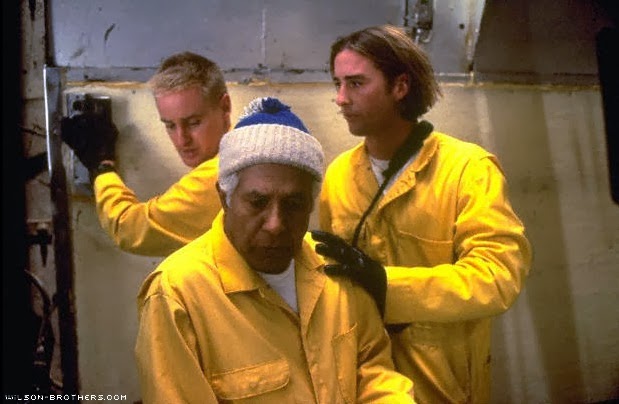
Pallana was discovered by Wes Anderson and the Wilson brothers at the coffee shop in Dallas which he owned. They then gave him a small role in “Bottle Rocket.” Then he just kept popping up again and again until he became just as memorable a part of Anderson’s world as colorful wallpaper and Kinks songs.

I don’t know why Pallana was always so funny to me. Maybe because he would just pop up, say one barely audible line, and then disappear. Or maybe its because in “Rushmore” you can spot him in the background of one shot playing with a giant necklace, and he never says a word at all.

I remember him best as Pagoda in “The Royal Tenenbaums,” who was apparently an assassin in Calcutta at one point in time. In honor of Kumar Pallana, I have decided to compile all of my favorite lines of his from “The Royal Tenenbaums”:

“The black man ask her to be his wife.”

“There he is.”

“There he goes.”

“You son of a bitch!”

“Oh shit man!”

Here’s the obituary from his hometown paper.

Ten Years and Counting: How Kill Bill Changed My Life

It all started with a shelf at Barnes & Noble. I had just turned twelve and had gift card money to spend. And when I had a Barnes & Noble gift card, I was a man on a mission.

I was browsing around the DVD section. I wasn’t normally one to take risks in life and buy something before I had seen it, but something told me I needed something new. Also, “Return of the King” wasn’t out yet. I stumbled upon a copy of “Kill Bill: Volume 1.” I heard it was good, the commercials were really cool, and Uma Thurman looked irresistibly sexy in her yellow jumpsuit. So I decided why not. That night, I popped it into the DVD player (remember those things?), and was never the same again.


“Kill Bill” was the start of my insatiable film journey. Every film lover has that one film that just clicks with them. Even after I found out that “Kill Bill” was paying homage (a.k.a. stealing) from so many other movies, it didn’t destroy my love for it. All it did was lead me down a path to find as many of the movies as possible connected to the Quentin Tarantino universe. From there, I found Scorsese, Kubrick, Leone, Ford, Kurosawa, “Kung Fu,” and of course “Shogun Assassin.”
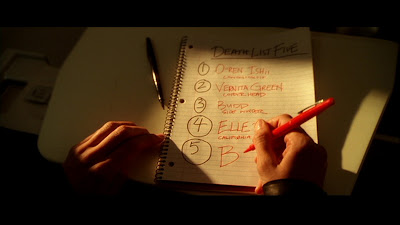
I wanna know about those other four death lists.

This week marks the ten year anniversary of the release of “Kill: Volume 1.” This is the only anniversary I’m allowed to acknowledge of course, because it has a zero at the end of it. As these years have passed, I have had many more chances to view both parts, whether it be on DVD, HBO, or TNT*, and I’ve come to see that I love “Kill Bill” not just for what it inspired me to do, but for the film itself.

“Kill Bill” was meant to be one film, but it was split in half for running time and probably profitability, too.** However, I acknowledge both of them as two very separate films. I’ll mostly talk about Volume 1 here, as that’s the one celebrating the anniversary, but some discussion of Volume 2 will be absolutely necessary.

When I first watched “Kill Bill,” I had simply never seen anything like it. Forget about the fact that I was only 12 and “Kill Bill” earned its hard R. “Kill Bill” gave me a lot of mixed emotions. Before this, I figured that violence was something needed to be handled delicately. That was before I watched O-Ren Ishii chop off a man’s head followed by a gigantic geiser of blood. It was shocking, but I couldn’t stop laughing. At first, I thought there was something wrong with me. Then, I found out that sometimes its okay to make violence funny. After all, it wasn’t like Tarantino was advocating mass beheading of any sort. No, this was just a different universe where dismemberment leads to insane amounts of blood. This was also the first time I realized that a film can be a fantasy even if it didn’t involve dragons.

“Kill Bill” was also the first revenge fantasy I ever watched, and for some reason the morality of revenge tales really stuck with me. It even lead to the script of my first student film which I am absolutely ashamed of and you can absolutely find it on my Facebook, watch it, and then point and laugh at me.

More importantly, “Kill Bill” skewed my idea of what a hero was. Before I ever laid eyes on Volume 1, I was obsessed with “The Lord of the Rings” trilogy. Not the books, of course, because that’s what ADD does to you. I was used to the “Once upon a time/and they lived happily ever after” form of storytelling. Then came along “Kill Bill,” where the villains were humanely despicable*** and the closest thing to a hero was a woman who could pluck somebody’s eye out. As wildly unrealistic as “Kill Bill” is, this feel’s a little bit closer to real life: sometimes, good people do bad things and bad people have motivations behind their actions. Have you looked at TV lately and maybe heard of a show called “Breaking Bad”?

Tarantino doesn’t make personal or biographical films, but everything he makes feels directly like a portal into his brain. “Kill Bill” was also one of the first times I ever realized the beauty of great dialogue, and that it could be used for other purposes besides exposition. Throughout both volumes, there are a tremendous amount of classic monologues and bits of dialogue that are among the best that Quentin has ever written. The best monologue of the two volumes is Bill’s speech about Superman. It is so deep and thoughtful and informs the film while incorporating popular culture so well, that it makes me think that Tarantino also would have been a very successful film critic. Additionally, Tarantino’s heroes might all be evil, but they are also all obsessed with movies and TV. Finally, the film fanatic gets a chance to be the hero.

Sure, there were other films before this that had all of the qualities that made “Kill Bill” so great. But this was my introduction to all of it, so it will always remain the best to me. I am not quite sure what I’d be doing today if not for “Kill Bill.” I’d be a completely different person. And cinema would be different, too. How often do we get characters as memorable as the Bud, Bill, Elle Driver, or The Bride anymore?  Not to mention, Volume 1 still has my favorite cliffhanger twist ending of all time. Take that, Shymalan.

Additional Notes

  • I will never forget how confused I was the first time we found out Beatrix Kiddo’s name and cut to that flashback where she’s in school but still a grown up. Quentin is weird, man.
  • Favorite line of dialogue: Bitch, you can stop right there. Just because I have no wish to murder you in front of your daughter doesn’t mean that parading her around in front of me will inspire sympathy. You and I have unfinished business. And not a goddamned thing you’ve done in the subsequent four years including getting knocked up is going to change that.
  • Which one of Tarantino’s muses is better: Uma Thurman or Christoph Waltz?
  • “Silly rabbit” “Trix are…” “For kids”
  • Greatest little touch: the little wooden water fountain bobbing up and down as O-Ren and Beatrix fight in the snow.
  • I’m pretty sure the House of Blue Leaves scene switched to black and white so it wouldn’t get an NC-17 rating. However, it also worked as an amazing artistic decision. Sometimes, censorship can do great things for art.
  • The fact that neither “Kill Bill” got nominated in major categories makes sense I guess (old farts), but how could they pass up Uma Thurman and David Carradine? 
  • Other acting MVPs: Everyone in the cast. Everyone. 
  • Need to make a serious note on Michael Parks. In an interview, Tarantino once said he thought that Parks was as good as Dustin Hoffman. I don’t think he’s being hyperbolic. It is too bad that Parks never rose above B-movie star. He plays two different characters here, the first is Sheriff Earl McGraw (“son number one…this tall drink of cocksucker ain’t dead”). Then in part two, he plays Esteban Vihaio in a performance that’s strange, funny, and ultimately too brief. 
  • Another note on Parks: Tarantino is known for giving a lot of former stars their big comeback roles. I would gladly trade every role that Travolta has had after “Pulp Fiction” for more movies starring Michael Parks. 

*TNT is the king of showing the most rewatchable movies of all time. They’re also the king of inexplicably awful censorship decisions.
**Don’t feel so groundbreaking now do you, “Twilight”?
***Yes, Bill’s a psycho. But he also had his heart broken. Even a man who loves to “travel around the world and kill people for vast sums of money” can fall in love.
****Footnote