Category Archives: Movie Review

Movie Review: 2012

I picture Roland Emmerich, director of “2012,” being something like Woody Harrelson’s character in the film: standing on top of a mountain, and cheering as the world came to an end.

Yes, “2012″ is what some might describe as “death porn” or “destructo-porn.” It’s a disaster film based on an old conspiracy that goes where so many disaster films before it have gone. It’s a marvel of special effects, but an absolute disaster in story telling.
“2012″ is based off the popular conspiracy that on December 21, 2012 the world will end because it’s the very day the Mayan calendar ends. Hours of unnecessary footage on the History Channel have tried to take everything from history and put it together to convince us that it will happen.
Now, I’m not saying I didn’t like “2012″ because I don’t subscribe to this whole theory. Let’s take a look at the story to see what is actually wrong with it.
The film has multiple story lines. One involves the President of the United States (Danny Glover) and two scientists: one with good intentions (Chiwetel Ejiofor), and another with shadier intentions (Oliver Platt).
The most important story involves Jackson Curtis (John Cusack). Jackson is a divorced writer who must get his two kids, his ex-wife (Amanda Peet), and her annoying new husband (Tom McCarthy) to safety as the world crumbles. That seems nice, until you realize that it’s the exact same plot of Spielberg’s “War of the Worlds.”
The rest of “2012″ basically involves the audience watching the world get destroyed. The Los Angeles freeway collapses. The Vatican crushes an entire crowd. The White House is crushed by a giant tsunami. Yellowstone National Park turns into a giant volcano. This then goes on for another two-and-a-half hours. It’s entertaining, and even a little enthralling at first. But after a while, you’re just waiting for it all to end.
Don’t get me wrong, I love a good, special-effects laden blockbuster. If done well, it can make for great cinema, and even greater entertainment. However, what prevents “2012″ from the possibility of being good is Roland Emmerich. Emmerich you could say is obsessed with destruction, as he also directed “Independence Day” and “The Day After Tomorrow.” It’s a testament to how lazy “2012″ is when you see that it has literally the exact same closing shot that “The Day After Tomorrow” had. That’s right, Emmerich ripped off himself.
Anyway, Emmerich’s problem is that he cares more about the spectacle, than the humanity. As a giant earthquake splits the earth in two, splitting streets and causing buildings to collapse, thousands of innocent people crash to their deaths. They are not seen as humans, but merely as small specs in the distance. Even when main characters die, nobody seems phased by it in the slightest bit. Perhaps most tastelessly, is when an entire office building filled with people collapses, but the only thing we’re supposed to be paying attention to is that the family got away safely in a jet. How can we cheer for one person, when everyone else around them is dying? Quite ironic for a film that preaches to remain humane in dire times.
For films like this, one should leave the idea of reality at the door. Good movies can suspend your disbelief from reality, but bad movies make you wish they had a little reality injected into them. How is it that Jackson and his family can narrowly escape death that easily? Not to mention, most of what is passed off as sound science in this film is completely wrong.
Possibly the one redeeming aspect of “2012″ is Woody Harrelson’s hilarious performance as an apocalypse-loving DJ. Seriously, this man can make eating a pickle seem funny. Most importantly, Harrelson looked like he was having a good time. Too bad no one else in the cast was.
Emmerich not only directed the film, he also co-wrote it. And what an awfully written screenplay it is. It’s filled with so many inconsistencies and gigantic plot holes. Not to mention, it also makes the main character incredibly unlikable. I know that some people in life are bad people, but shouldn’t the guy we’re rooting for be at least a little bit nice. He can’t even obey a clear “No Trespassing” sign.
I’d like to say that despite the flaws “2012″ is nonetheless a good, entertaining time at the movies. It is, for about an hour and a half. The rest is dull and often laughable. The viewer can never really enjoy any of the film’s thrill’s because of how much is happening at once. Emmerich can’t decide which way the world should end and therefore decides to gives us every possibility. “2012″ might’ve been more enjoyable if it paced itself better.
Maybe the worst part of “2012″ is the sense of smug superiority that it gives off; it believes itself to be much more intelligent that it actually is. At one point, the last survivors on earth board a life-saving ship known as the Ark. There’s also a character named Noah on it. Coincidence?
I hate to call a film sadistic, but “2012″ truly is, as it is not a celebration of life and survival, but rather a film that enjoys at the destruction of a planet and the loss of life. You’re bound to have a more entertaining time looking at the crazy 2012 theories online, then spending $10 on this film.
Better Apocalyptic/Disaster Thrillers: Children of Men, War of the Worlds, Zombieland, Jaws, Akira, 12 Monkeys, Wall-E, Planet of the Apes, Titanic

Movie Review: Gangs of New York

Of all of the stunning images from “Gangs of New York,” one that sticks out is a shot that starts off on street level, and continues to go higher and higher until the 19th Century style buildings become the shape of the island of Manhattan. Here is a city that, over the years, I’ve grown to know and love. Here it is, in a form like we’ve never seen before.

“Gangs of New York” is Martin Scorsese’s latest vision of the mean streets of his beloved New York. However, it takes place 100 years before the days of “Mean Streets” and “Taxi Driver,” during Civil War ravished America.
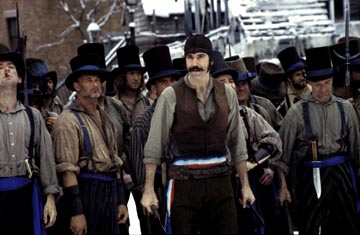
The film starts off during a vicious gang war in 1848. Amsterdam Vallon (Leonardo DiCaprio) is the son of respected Irish immigrant Priest Vallon (Liam Neeson). On the opposite side is Bill ‘The Butcher’ Cutting (Daniel Day-Lewis). Bill is the glass-eyed son of a Revolutionary War soldier who gushes with patriotism. He’s known as The Butcher not just for his day job, but for his weapon of choice.
As tensions rise between the Irish and the so-called ‘Natives,’ Bill murders Priest. Many years later, Amsterdam returns to a corrupt, Boss Tweed ruled Five Points and seeks revenge.
“Gangs of New York” shows Scorsese’s recent fascination with American culture wars, as this film can be seen as something of a counterpart to his recent “The Departed.” However, this film explores the roots of American diversity. It’s about the earliest days of bigotry, much of it rising from immigration. In a way, much of the situations and dialogue sound frighteningly similar to the current national conversation on immigration.
Adding on to this is the near accurate version of history portrayed. While Hollywood will often portray history through a myopic lens of clean precision, Scorsese takes no shame in showing the filth, the blood, and the anger that shaped this era. Extra special attention is paid to the stunning sets. At times, it can distract from actual plot depth, but it definitely helps raise the story’s level of believability.
Of course Scorsese’s direction is excellent, but what stands out most is Day-Lewis’ performance as Bill the Butcher. He is truly the best actor of this generation, and the carrier of the method torch. He steps into the character and makes him both a blood-thirsty savage and a patriot feeling betrayed by a country he helped defend. He may be racist, but his feelings can be understood. Not to mention, all he has to do is sharpen a knife, or just squint his eyes to become the most intimidating presence in the film. He basically steals all chance for any other actor in the film to shine.
Now, back to Scorsese. What makes Scorsese one of the great directors of cinema is that he knows how to handle violence better than any other director. Of all of his films, “Gangs of New York” may be his bloodiest. While most directors might show someone being stabbed and barely show the consequences, Scorsese slows things down and allows us to see the horrible, dehumanizing consequences of each kill. Later, after another major battle, the cobblestone streets turn into a red river. To Scorsese, violence isn’t something to cheer on or admire, but rather something to be sickened by. Meanwhile, the aerial shots of the war dead are reminiscent of the sprawling images of the dead in “Gone with the Wind.”
Upon its release, “Gangs of New York” divided audiences right down the middle. I believe it is a minor masterpiece; it doesn’t reach “Goodfellas” or “Raging Bull” heights, but its certainly no sign of a Scorsese downfall either. The film runs over two and a half hours yet races by as Scorsese explores his favorite themes of honor, religion, and family. Like in any Scorsese film, the backdrop, cinematography, editing, and score of “Gangs of New York” is extremely well detailed and masterful. They portray the chaos of the era in the same way that each room in “Goodfellas” distinguished when exactly Henry was doing well or doing poorly. And while some have criticized that too much is covered at once, it all serves to cover the chaos.
Part of the problem could be in the story itself. While Scorsese at first creates the interesting idea that while Bill hated Priest, he had a deep respect for him. Once the conflict between Bill and Amsterdam arises that inexplicably seems to disappear from the film together with little explanation. Many scenes also seem pulled right out of the revenge film playbook. For example, the scene where Amsterdam saves Bill’s life so he can later murder Bill himself is pulled straight from “Once Upon a Time in the West.” A little clarification is never a bad thing.
But, these are just minor flaws. Overall, “Gangs of New York” exceeds its epic counterparts (mainly “300″) in creating a vision of the past that’s exciting and fascinating without actually losing a grip on the history part. It’s a beautifully made history lesson about the birth of a nation and a bitter love letter to a city that spawned one of the greatest directors of all time.

Movie Review: Zombieland

There is a little, important secret of horror filmmaking I’ve been picking up on lately. That little secret is that less is more, that what we don’t see is scarier than what we actually do see. Even though much blood and guts is spilled in “Zombieland,” much is still left up to the imagination. This helps keep the film from being wannabe shlock to a totally satisfying horror satire.

“Zombieland” takes place in a post-apocalyptic Earth, long after a virus has turned most humans into cannibalistic zombies. The world has now become a Darwinian society, where all you need are a few basic skills to get by. One of those people lucky enough are Columbus (Jesse Eisenberg). Columbus is a scrawny, awkward college student who manages to get by unscathed because he’s so used to loneliness.
While trying to reach his parents in Ohio, Columbus meets the tough, potty-mouthed, yet ultimately tender Tallahassee (Woody Harrelson). As they head east, they meet two con women: Wichita (Emma Stone) and Little Rock (Abigail Breslin). The rest of the plot mainly consists of them traveling cross country, searching for safe haven as Columbus begins to fall for Wichita.
As you’ll notice, each character is named after a different city. They each name themselves after the destination they are headed to, whether it still exists or not out of confidentiality reasons. It seems kind of ironic that they want their names to be secret though, as they end up becoming something of a family in the end.
In my introduction, I made the film seem like too much of a pure horror film. That, it isn’t. I only felt frightened at a few moments in the film, but then again, “Zombieland” was meant to be a satire, and not a horror film. That doesn’t mean it’s not directed like a good horror film though. Take the convenience store scene. The most brutal death involves Tallahassee, a zombie, and a pair of hedge trimmers. We don’t see what exactly the trimmers do, but we do see them slide across the floor, covered in blood. It’s inferring what happened, rather than actually seeing what happened, that challenges the viewer, builds suspense, and just makes it even creepier to ponder. However, “Zombieland” does show us a good amount of graphic blood and guts. However it’s much more sparse than you might imagine, and it mainly happens at the way beginning. It’s almost like director Rubin Fleischer’s way of saying “there’s the gore. Happy now? Can we just move on?”
I can’t forget that “Zombieland” is first and foremost a satire. Unfortunately, I’m not well-versed enough in the zombie genre to say whether or not “Zombieland” effectively both pokes fun and pays tribute to the popular genre. However, the film may also be a satire of the horror genre in general (I picked up a reference to the banjo scene in “Deliverance”). I could spot even smaller possible satirical spots. Some of them could even be the more predictable moments of the film, possibly mocking how formulaic the genre has become.
The humor of “Zombieland” is buoyed by its two central performances. While it might be cool at this point to bash Eisenberg for playing the same character he played in “The Squid and the Whale” and “Adventureland” I’m going to go against the tide and say he gave a good performance because I like him and well, if someone is good at playing a certain personality, why shouldn’t they be allowed to keep playing it?
Mainly, Harrelson’s performance as Tallahassee steals the show. The writers give him a few great lines (“That’ll do, pig”), and he does such a great job at delivering each one. Harrelson plays Tallahassee slightly like Mickey from “Natural Born Killers,” if Mickey had a soft spot and a love for Twinkies.
Stone doesn’t bring a huge amount to the table, but she doesn’t really detract from the story at all either. Breslin, however, does a great job with the material. After this and “Little Miss Sunshine,” she proves that she can handle more adult material better than most girls under 18 [Editor’s Note: Let’s say for example, Hannah Montana, who’d I’d love to see be eaten by zombies]. The film also includes an extremely random, yet hilariously and even refreshing cameo. I dare not give it away here; I don’t want to ruin the fun for you.
“Zombieland” isn’t perfect. It’s short and it isn’t the first zombie satire ever made (there’s also “Shaun of the Dead” which, for the record, I still haven’t seen). But why did I like it so much? Mainly, its 81 minutes of pure, blissful, escapism. It’s the kind of escapism that will draw you out of reality and further and further into the world of movies. This isn’t a Seltzer-Friedberg satire, it’s the kind that has a deep knowledge, and even a deep respect, for the subject its consistently mocking. Not only that, but it stands as a comedy in its own right, with its own, original jokes, as well.

On A Second Viewing: A Serious Man

Warning: May contain some brief, spoiler-ish details. Proceed with caution.
After I first saw “A Serious Man,” I knew I liked it. I mean, how could I not like a film by the Coen Brothers?
However, there were a few things still bothering me. Well, mainly, it was that ending. Abrupt endings can be annoying, but I never hate them. All they involve is mulling over, and extra viewings. This was the case for “A History of Violence” and “No Country for Old Men.” It was also the case for “A Serious Man.”
But let me backtrack, so you can see the ending for yourself. I’m going to backtrack all the way to the beginning, to the mystery of the dybbuk. The Coen Brothers have repeatedly said that this story has no meaning, but I believe that there is something in there. There are three possible theories to this scene:
1) The couple were Larry’s ancestors. Stabbing the dybbuk unleashed a centuries long family curse.
2) The man was not really a dybbuk. His unfortunate death mirrors Larry’s struggle of how bad things always seem to happen to those who just try and commit mitzvahs.
3) It’s both. Or neither.
It could be any of those answers. But the more I think about it, the more I believe it is the last one. That’s the one that breaks the lock, and provides that any answer be correct. In the end, the dybbuk walks out into the snow. The Coen Brothers never show us whether or not he died or just kept on into the night, getting ready to haunt more unsuspecting citizens. What this scene truly does is act as a mini movie in preparing us on what is to come. “A Serious Man” will not be like the typical film that provides you with answers. Here’s one where you’ll have to come up with the answers on your own. And it won’t be easy.
A technique the Coen Brothers use constantly throughout their films is repetition. One line repeated in this film is Larry’s insistence, “I haven’t done anything!” And this here, is the point of the film. Why is Larry suffering? True, he hasn’t done anything wrong, but he hasn’t done anything right.
One of the many things I got out of the film a second time around is just how deeply funny it is. The humor doesn’t always lie in one-liners, it lies mainly within the situations. There are many instances where you shouldn’t be laughing, but you do anyways. Will you feel bad for laughing at some of Larry’s ridiculous misfortunes? Then again, the film does tell us in the very first shot to take every minute with “utmost simplicity.”
In my first review, I gave praise to the film’s three leading men, Michael Stuhlbarg, Richard Kind, and Fred Melamed, but not as much praise as they deserve. While Kind was cast as the annoying relative he always plays, he manages to still make him as atypical as possible. Meanwhile, Melamed seems like a lock for best supporting actor as Sy Ableman. He is (if I’m reading the film right) the serious man of the title. And he plays Sy that way, portraying him with utmost scrutiny. He commands every shot he is in, taking it over, moving around characters by his own wishes and just carrying this feeling that he knows everything.
Then of course, there’s the other Oscar lock, of Stuhlbarg as Larry Gopnick. This is Stuhlbarg’s first big leading role, but he takes it like a pro. In the scene where Larry’s wife discusses a divorce, his pitch goes up to a high, whiny voice; giving Larry an almost lovable childlike ignorance.
The Coen Brothers are famous for emphasizing their characters’ quirks. Stuhlbarg basically does that for them, as he gives Larry a sort of chicken walk, especially in the scene where he waddles across his look, getting a peak at the forbidden temptation that lies just over a small white picket fence.
While that serious man in the title could refer to either Sy or Larry, there is yet another important (soon to be) man in the mix: Danny Gopnick (Aaron Wolff). He lives a life opposite of his father, only caring about smoking joints and watching “F-Troop” rather than trying to be a mature, serious man. However, he, like every character, eventually faces just consequences for their poor actions.
A large controversy I’ve discussed with many people about this film is what kind of audience it was meant for. The idea that only a Jew could appreciate it is one I am beginning to find quite unfair. Just because I wasn’t raised Catholic, does that mean I can’t be stunned by the christening scene in “The Godfather?” Just because I’m not Italian, does that not mean I can’t be entertained by the wedding in “Goodfellas?” While maybe only those who were born Jewish will understand the anxiety of preparing to have a Bar Mitzvah, the Coen Brothers opened up a door to the Jewish culture. They are inviting you to stay and look around.
Now, there’s one point from my last review I’d like to correct. In my previous review, I seemed to stick to the theory that Larry’s story was a reflection of the story of Job. Well, it’s only half that. The other half is the possibility that Larry’s story reflects existentialism, rather than the existence of God. Larry’s miseries could be a test from God. Or they could just simply be life’s plan for him, and there’s nothing he can do about it (this scene reflects this idea).
Also in the mix, you could see Larry as a 1960s Jewish version of Hamlet; a man spending too much time overthinking life and trying to avoid a situation that simply cannot be avoided. He could even be a figure straight out of a Kafka* story: a good man who is so overburdened by a world that demands too much responsibility out of him.
It’s simply possible that “A Serious Man” is every single one of these ideas. Or none of them. This makes the film a sort of “choose your own adventure” like story but this time, you have to choose your own theme. The Coen Brothers have thus constructed the rare film that’s a totally different experience to each and every member. Yep, the way a film should be.
But maybe the Coen Brothers, who are the absolute masters of trickery, are just leading us into a giant trap. They awaited as critics and audience members alike overanalyzed every aspect of the film to death when they were missing the film’s real point: the danger of overanalysis. In the film, we learn in the end that the mystery of the goy’s teeth is solved once the dentist forgets about it. Perhaps Larry’s problems would have been nothing to him if he just, took a deep breath and forgot about them for a while.
So for now, I’m not going to fall for the trick. I leave the rest of the interpretations up to you.
*Tip for Aspiring Writers: A Kafka namedrop always makes you look smarter.
For further reference, here are a few great articles about the film:
I know I’ve written a lot here, but I still didn’t even get to touch on Larry’s neighbors, physics, respecting privacy, the wisdom of youth, and the film’s representation of connections within the Jewish community. Oh well, it doesn’t look like this is the last time you’ll be hearing about “A Serious Man.” Until then, I want you all to take a few minutes and enjoy one of the most meaningful parts of the film: the power of “Somebody to Love”:

Movie Review: Where The Wild Things Are

Like many children in America, I remember being read only two books growing up: “The Cat in the Hat,” and “Where the Wild Things Are.” The former got a movie adaptation that few would ever like to mention again, while the latter, after so many years, finally made it to the big screen.

“Where the Wild Things Are” is a movie adaptation I’ve been waiting for for quite some time. The idea of how someone could take 10 sentences and turn it into a feature length film fascinated me. The end result is something of a mixed bag; an intense labor of love that just isn’t given all the love it truly needs.
In order to make the story fit a feature length, director/writer Spike Jonze and co-writer Dave Eggers added a backstory. Young Max (Max Records) feels isolated from the rest of the world. He doesn’t have friends, he has an indifferent older sister, and divorced parents.
Just like in the book, Max’s frustrations mount to him donning the trademark wolf suit, biting his mother, and then sailing off to the land of the Wild Things. There, he meets the tough but lonely Carol (James Gandolfini), the bullied Alexander (Paul Dano), and the free-spirited KW (Lauren Ambrose).
Like in the book, Max becomes their king. Here though, he learns that it ain’t easy being in charge.
“Where the Wild Things Are” was brought to the big screen by one of Hollywood’s most wildly imaginative directors, Spike Jonze. This is his third film, following “Being John Malkovich” and “Adaptation.” His version of “Where the Wild Things Are” proves to be not only Maurice Sendack’s vision, but also his own. He turns the island of the Wild Things into a land of not only dense forests but also desolate, empty deserts. And there’s a giant dog.
Like “Being John Malkovich,” “Where the Wild Things Are” takes place entirely inside one person’s imagination. In this case, it’s in Max’s head. Unlike the book, Jonze doesn’t seem to distinguish between Max’s fantasy and reality. Perhaps this is his way of saying Max hasn’t entered the realm of early maturity yet, and the only thing that will accompany him is his dreams.
Before I dish out some complaints of the film, there are a few things here that must be praised. Mainly, it’s Lance Accord’s camerawork. His cinematography ranks alongside “The Assassination of Jesse James” and “Children of Men” as the best of the decade. Some of the best shots come during the “magic hour” of the day when the sun isn’t quite set, but still beams down in golden rays. The desert is used perfectly as a metaphor for Max’s isolation from humanity.
But maybe most profound is the way the Wild Things themselves are depicted. Instead of choosing CGI, Jonze went with old fashioned puppetry. While on set, Records was never talking to a green screen, but rather living, breathing creatures. Then, there’s the way they are introduced. While most directors might make a big deal out of it and create a slow, painful introduction (i.e. Peter Jackson’s “King Kong”), Jonze shows us the Wild Things just seconds after Max arrives.
When I left the film, I felt conflicted. I knew there was something missing from the film, but I just didn’t know what. While it’s understandably hard to turn 10 sentences into an entire film, the approach seemed a little backwards. In a way, almost nothing seems to happen in the film. While the Wild Things certainly are given a human face, some of the conflict felt a little forced. At one point, Carol asks Max if he knows the feeling when your teeth spread apart as you get older. Lines like this sound more like Andy Rooney observations than actual thematic discussion.
Maybe “Where the Wild Things Are” could also be a victim of bad timing. The film about the child who creates a fantasy world to escape their horrible reality has become quite commonplace. It was done best most recently with “Pan’s Labyrinth.” In a way, I wish Jonze laid the plot out a little more like that film. “Pan’s” felt more like a story with actual challenges facing Ofelia in her own fantasy.
In the end, I still do appreciate everything Jonze did to make this movie. I call it a labor of love because I know Jonze truly did all he could to get his vision on the screen. It’s a labor of love like Copolla’s “Apocalypse Now,” Ridley Scott’s “Blade Runner,” or Tarantino’s “Inglourious Basterds” in which the style is so flawlessly executed that most might lose the meaning of exactly what was going through the director’s head. Could this version of “Where the Wild Things Are” be so personal to Jones that it might just be lost on us?
Max was a hero to me in my youth and his character continues to interest me. Jonze makes him out to be not just an outsider, but also something of a misguided rebel. Could he be a boy with no love in his life who deserves it like Jim Stark? Or just someone as emotionally immature as Holden Caufield?
But let’s not over-analyze. The simple message of this film is the power of a little bit of love. It’s a message so simple yet so brilliant that only 10 sentences are needed to fully illustrate its power.

Movie Review: A Serious Man

The very first scene of “A Serious Man” is a short fairytale set in a Polish shtetl. While one can spend hours figuring out how this fable connects to the rest of the film, interpretation is futile. Directors Joel and Ethan Coen have repeatedly stated that this story had nothing to do with the rest of the film. So, why put it in? Because, we have officially entered the world of the Coen Brothers, a world like few others; a world where they can do whatever they like.

How does one make the sudden leap from 1800s Eastern Europe to 1960s Midwestern America? Simply, with the stunning jump from a snow covered village to the inside of an old headphone blasting Jefferson Airplane’s “Somebody to Love.” It’s a transition that reminded me of Kubrick jumping from dawn of man to the space age in “2001: A Space Odyssey.” This is the very first glimpse of the world we’ll be looking at for the next two hours.
“A Serious Man” is the Coen Brothers at their most schadenfreude. The unlucky schlub they focus on this time is Larry Gopnick (Michael Stuhlbarg). Gopnick is a physics professor at a Minnesota college in 1967. He embodies the “nice Jewish boy” that all Jewish mothers hope their daughters will someday marry.
While Larry tries his best to be a mensch, his life is an utter mess. His wife (Sarri Lennick) plans to divorce Larry and leave him for the too-nice-for-his-own-good Sy Ableman (Fred Melamed). His son (Aaron Wolff) spends more time getting high than studying for his Bar Mitzvah and his daughter (Jessica McManus) totally resents everything about him. Meanwhile, Larry’s brother Arthur (Richard Kind) can’t find a place to live. Elsewhere, he is tempted by a bribe and a seductive neighbor. In order to sort out his problems, he seeks the help of three very unhelpful rabbis.
When comparing “A Serious Man” to all other Coen Brothers films, it seems so similar but yet very different. It is quite possibly their most personal film. Not only does it mark their first film set in their homeland of Minnesota since “Fargo,” but it’s also the first time they’ve chronicled their childhood growing up in a suburban, Jewish, middle class family.
One of the most distinctive trademarks of a Coen Brothers film is its emphasis on each character’s quirks. Usually, these quirks, involve the accents, behaviors, or dialects of a certain area. However, the Minnesotans of “A Serious Man” don’t talk in that Scandinavian accent like the ones in “Fargo.” This film is more focused on the quirks of the Jewish community. The Coens focus on the hilarious habits of referring to non-Jews as “goy,” overly congested voices, or the habits of making weird nose sounds [Editor’s Note: Just spend a day with me, and you’ll understand this].
The Coen Brothers do not rely on these stereotypes as a way of being mean-spirited or self-loathing, but rather as a loving tribute to their people.
One of the greatest creative risks the Coen Brothers took in making this film was compiling a starless cast of mostly theater actors. This decision pays off, as the audience feels not so much focused on the actors as they are on the characters. Stuhlbarg steals the show as Larry. He makes Larry’s struggles seem too painfully real. Melamed turns Sy into someone you want to hug and punch at the same time. Perhaps the most recognizable actor in the cast is Kind, who is best known as Larry David’s annoying cousin on “Curb Your Enthusiasm.” Here, he is typecast as the bothersome relative but he manages to bring a level of depth to Uncle Arthur and helping create of the more emotional scenes the Coen Brothers have ever shot.
The second creative risk the Coen Brothers took here lies in the story itself. The plot never really goes anywhere in terms of action. And without giving much away, I’d just like to say that things just have a way of getting worse and worse for poor Larry.
Often the Coen Brothers are criticized for being so hateful toward their characters and making fun of them. However, they are filmmakers, and therefore observers. Why not mock someone when they do something that is, well, ridiculous?
One thing I sometimes tend to tire of in films are Biblical references. That’s mainly because directors will throw in an image of some guy laying with his arms spread out, call it a Jesus metaphor, and then beg for an Oscar.
However, the Coen Brothers are not like that. They use Torah stories and Jewish myths to create a story that questions but doesn’t deny the existence of god, one that tries to determine how one can keep the faith in such a cruel world.
I unfortunately don’t know enough Biblical tales to point out exactly which ones were used here. Many have pointed out that Larry embodies Job, another good person whose constant suffering was a test by God. I found the story to be an allusion to Adam & Eve. Larry’s nearly perfect suburban street could be his Eden, while the temptations of money and adultery are his equivalent of the Tree of Knowledge.
At the end of the film, audience reactions seemed mixed. Maybe the reason I liked the film so much wasn’t just for a Coen bias, but because of a deep personal connection to it. I remember the days of listening to recordings of my Torah portion to prepare for my Bar Mitzvah and even more so how surreal the actual day felt.
You can be either Jew or Gentile to enjoy the darkly comic “A Serious Man.” It’s a film that will entertain, frustrate, and infuriate. Most importantly, there is not one answer to the films religious questions about life. It does what a great movie should do: rather than interpret itself, it lets the audience member interpret it instead. Does the film believe in God? Is the film existential? What does that tornado mean? To all this, I say; oy vey.
Unfortunately, this deeply intelligent film is only playing in a few places nationwide. To see it for yourself, either head to New York, or write Focus Features a letter and beg them to release the film in your hometown already. It’ll be a much more enjoyable evening than the one you’d have seeing “Couple’s Retreat.” Also, leave all interpretations of the very open-ended ending in the comments. I’m still very confused by it as well.
If You Liked this Movie, You’ll also Like: Fargo, The Big Lebowski, No Country for Old Men, American Beauty, Blue Velvet, Lolita, anything really, really, Jewish

Movie Review: Contempt

“The cinema is truth twenty-four times per second.”

-Jean-Luc Godard
The very first shot of “Contempt” is something of a mind trick. From off in the distance, it looks like we’re seeing a few small children, running with the wind, as one of them holds a white balloon. It is a moment of simplicity and freedom. Suddenly, as the children get closer, we see that these are no children.
What it really is is a man holding a boom mic, and a camera on a track following a wandering woman. We are not in reality right now. Welcome to the world of movies, within this movie.
“Contempt” was released in 1963, riding toward the end of the brilliant French New Wave. It makes sense, as in a way it seems to encapsulate the new feelings toward the art of cinema in the era.
The story focuses on struggling screenwriter Paul Javal (Michel Piccoli). Javal is invited to Italy by American producer Jeremy Prokosch (Jack Palance) to write a screenplay for a new version of “The Odyssey.” Prokosch is having some creative struggles with the film’s director, Fritz Lang (Lang plays himself). Paul reluctantly accepts, hoping that writing this screenplay will give him the money to pay for his apartment. While Paul finds himself struggling with Prokosch, he also struggles to keep his marriage with the beautiful Camille (Bridgitte Bardot) from falling apart.
“Contempt” is one of those movies that’s about making movies. While most movies of this nature focus on biting the hand that feeds it, “Contempt” only takes nibbles. It seems more sad than angry. Paul must give up the sanity of his life just to get this screenplay done. And what is he doing it for? Just the money?
I wouldn’t be surprised if director Jean-Luc Godard faced these conflicts himself while making his films. Each film he made expresses some form of the audacity of the New Wave. “Contempt” takes it to a new level. The images of Camille’s nude form may be among the first in cinematic history. This was something that could never be done in American movies at the time, thanks to the Hays Code. Along with this, there are also a few grizzly images of violence, and a scene where Camille spews out a list of curse words. This scene is somewhat funny; it’s like Godard’s way of showing off that this is his film, and he can do whatever he pleases with it.
Then again that’s also sort of the theme of the French New Wave: that the film is in the hands of the director. The director is the author of the film. And Godard, of course, is a fine director. Every shot of “Contempt” is filled with the utmost passion. Godard makes brilliant uses of tracking shots and long shots. Also, he uses the objects within the film such as statues and walls to emphasize character relationships. The bizarre version of “The Odyssey” contains shots of the camera staring at statues of the gods. Meanwhile, as Paul stands on one side of a wall and Camille on the other, we can already tell this relationship is going south. And of course, the shots of the rocky Italian coast are absolutely breathtaking.
While Godard is a great filmmaker, he never seems to get inside his characters’ heads. Each one can often seem a bit trite and artificial. Maybe he did that on purpose here, as most of the people are well, trite and artificial. In the New Wave era, Godard was the master of technique and Truffaut was the master of character.
However, one character in “Contempt” doesn’t feel artificial: Paul. Godard makes him out to be like Odysseus. Like Odysseus, he’s strong-willed yet the forces of nature seem to be against him as he tries to achieve his goals. But unlike Odysseus, there is no loyal wife at home waiting for him.

Movie Review: The Informant!

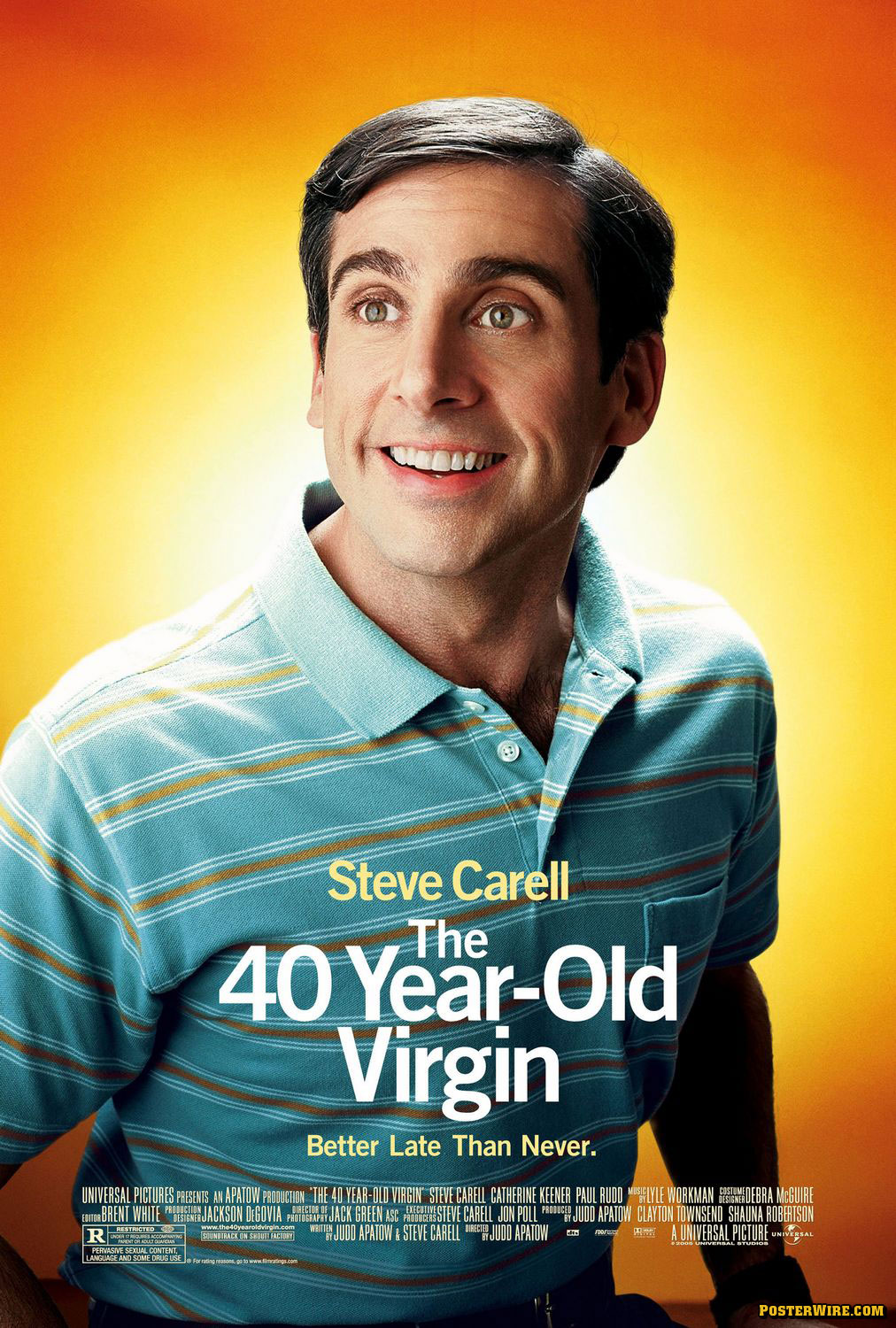
The poster for “The Informant!,” at first glance, reminded me of the poster for “The 40 Year Old Virgin.” Not only did both include two overly jolly men, but there was just something about them that made me happy every time I looked at them. Like the poster for “Virgin,” there was something so incredibly funny, and so incredibly strange about the poster for “The Informant!” that I just had to see it. It turns out, the movie is both of these things, in ways different than you might imagine.

“The Informant!” is based on the true story of one of the biggest (and weirdest) financial frauds in American history. However, it tends to take its history quite lightly. After a title card informs us that the film is based on a true story, we are treated to the sentence “So there.” Off the bat we are being told to expect nothing short of a comedic version of true events.
The corporate fraud focused on in the film is that of the major price fixing [Editor's Note: Please, don't make me try to explain what that is] that took place in the early 1990s at the Illinois food processing company Archer Daniels Midland (ADM). The seemingly innocent biochemist turned businessman Mark Whitacre (Matt Damon) becomes an informant for the FBI, who looks to bust the company. However, agents Bob Herndon (Joel McHale) and Brian Shepard (Scott Bakula) soon realize that Whitacre’s ineptitude might get them into more trouble than they could have ever imagined.
Commercials for “The Informant!” have made it out to be purely comical. While the film is hilarious at times, it’s not as much as a comedy as you might expect. While director Steven Soderbergh could’ve taken this exact same story and turned it into a dramatic, suspensful thriller on the level of “The Departed” or his own “Traffic.” Instead, he twisted it around and turned it into a light-hearted, comedic thriller with serious undertones. I’m happy he decided to take this path. Had the film been more serious, it probably would’ve seemed much less original.
Parts of “The Informant!” feel like a tribute to the great film noir of the past. Everything from the opening credit font, to the tangled web lies, feels right out of the paranoid thrillers of the 1970s. Meanwhile, the somewhat jazzy musical score could be traced all the way back to “The Maltese Falcon.”
Maybe the greatest reward the film gives is the pleasure of seeing Damon play Marc Whitacre with complete scrutiny. Damon pulled a De Niro for this performance and gained over 30 pounds to fully embody the everyday schlub that Whitacre truly was. In his performance, Damon is funny at all the right moments, tricky at all the right moments, and serious and self reflective at all the right moments. But most importantly, he always looks like he’s just having a good time in the role. When it doesn’t look like an actor is having a good time in a comedy, you know you’re in trouble. Damon looks like he’s having a blast.
Making up the rest of the ensemble are many comedians who now seem to be slipping into more dramatic roles. McHale, who started this week off good with his first real acting job ever in “Community” scores once again, getting one of the film’s biggest laughs with just a small facial expression.
While some perceive the humor to be a little smug and condescending, I remain a firm believer that in a smart film, structure relates to function. And here, the function is to almost give us the feeling of how overly smug some of the men must’ve been, thinking that even as they drew themselves closer and closer to being caught, that they remained invincible. Also fascinating is Whitacre’s narration. It doesn’t really do much to enhance the story or give us background details, it is basically just a stream of consciousness. It gives us a feeling of what goes through Whitacre’s head everyday. However, some of these details may actually be important. Or they may not. Maybe they’re just leading us into a big trap. The truth never is what it seems.
As the great line in “Some Like it Hot” goes: “Well, nobody’s perfect.” “The Informant!” certainly isn’t. It doesn’t really get interesting until the FBI gets involved, and often times its not as funny as it thinks it is. But it was one thing: really entertaining. It is so rare that you see a movie like “The Informant!” that provides the audience entertainment in a sophisticated and adult way. It is hip, yet it is also versed in the classics. It provides a history lesson without putting its audience to sleep.
But after all is said and done, you know what the funniest part of the film is? The fact that the real joke of the film is on you.
Recommended for Fans of: Sex, Lies, and Videotape, Catch Me If You Can, Wall Street, Traffic, The French Connection, The Maltese Falcon, Chinatown

Movie Review: Extract

It seems fitting that “Extract” takes place in a vanilla extract factory, since the film is about as plain as the flavor itself. And the saddest part is, it comes from one of Hollywood’s most creative directors.

“Extract” is a comedy. Sometimes, it’s a spoof on work hell. Other times, it’s a spoof on suburbia. And then the rest of the time, it’s supposed to be a comedic crime caper. It never really takes a stand at specifically which one it will be, and not a single one of these ideas ever seems to connect.
“Extract” is directed by Mike Judge, whose previous comedy about life at work is, of course, “Office Space.” This time, rather than being from the perspective of the miserable mid-level worker, it’s from the perspective of the stressed out boss. Joel (Jason Bateman) owns a successful flavor extract company. He’s about to make a fortune by selling his company to General Mills until a freak accident in the factory leaves a worker without a testicle. His replacement is an attractive con woman named Cindy (Mila Kunis). She seems nice, but she’s secretly trying to con the company out of millions of dollars.
Back at home, Joel’s life is even more complicated. He has major sexual troubles with his wife (Kristen Wiig). This is what will eventually set the stage for some bad advice from a drug-loving bar tender (Ben Affleck) and a doomed relationship with Cindy.
Those are the two plots of Extract. If Judge wanted to make a better movie, he should’ve just stuck to one of them. And in my opinion, it should’ve been the hard working, frustrated boss tries to make things work at work and home. The con woman plot goes absolutely nowhere.
How Judge could make such a poorly executed comedy is beyond me. Not only did he direct “Office Space,” he also created “Beavis and Butt-head.” While many people without a sense of irony thought this show was just plain dumb, it’s actually about the humor of observing dumb people. “Extract” certainly could have had some of that. At one point, Joel points out how all of his workers are giant babies, and he is like their babysitter. We see the workers’ work habits. While the workers’ work habits are annoying, they’re never particularly hilarious. None of them seem to have those Milton-like qualities.
Like any Mike Judge film or show, “Extract” is filled with a wide variety of characters defined by their quirks. Usually these quirks include a less than intelligent brain, or a strange way of speaking. Maybe the best one in “Extract” is Joel’s nosy neighbor Nathan (David Koechner). However, his quirks aren’t shown in a lovable way. They’re shown in a more “I want to punch this guy in the face” way.
Maybe the reason many of the characters don’t work is because Judge underutilizes his obscenely talented cast. J.K. Simmons is barely given a funny line, and his role in the film is never defined. Wiig is great at playing shy and asexual, but again, she’s given few chances to be truly funny. And while I was most looking forward to seeing Affleck (what? he’s funny), he is given too little screen time. I always enjoy Jason Bateman, and here I think he did his best to re-create his other famous frustrated boss role: Michael Bluth–if only this film could’ve been more like “Arrested Development.” However, there are two bright spots. Kiss’s Gene Simmons does a hilarious job portraying a sleazy lawyer, and Dustin Milligan gets some of the film’s best laughs for playing the brain dead gigolo Brad.
I don’t want to give “Extract” as bad a review as I could because I know there’s potential for a great movie in here. That potential is perhaps best seen at the film’s end. The ending has an underlying, subtle humor to it and an almost moving, human quality. It is the ending to a film that never actually existed. That end scene showed the film’s true, wasted potential.
Judge is one of Hollywood’s most under appreciated talents, and I thought “Extract” would become another underrated cult hit. It had potential. If only it had emulated that ending scene and been the kind of satire of American life Judge is so great at doing, than this comedy would’ve been an instant classic.

Movie Review: The Final Destination (3D)

When did audiences stop caring about life and start cheering on merciless, unnecessary death? I didn’t realize this was the case until I sat through “The Final Destination.” In 3D. And felt myself cheering too.

Maybe it wasn’t such a bad thing that we were all cheering. After all, what sympathy could be felt for the characters? Not one felt the least bit developed. Well, maybe a little bit. The most I could say is that Nick (Bobby Campo) goes to a race car event with his friends. There, he has premonitions of a disaster in the stadium causing brutal death. Him and his friends, along with a few others, narrowly escape the carnage. They have cheated death. This sets off a chain of events that leads to each of them being killed off in the most unpleasant ways imaginable. Oh, and Nick also has a friend named Hunt (Nick Zano) who’s kind of a tool. I don’t remember any other of the characters’ names. And I don’t really care. 
The actors certainly don’t help bring sympathy to the characters. Their dull and lifeless delivery bring nothing to the script; not that there’s anything good to the script. The dialogue is nothing but a series of platitudes and cliches. At one point, one character actually says “you only live once” and tries to pass it off as original, moving, and insightful. Of course, it is none of these things. 
The film’s director, David R. Ellis, has a strange resume that includes “Final Destination II,” “Snakes on a Plane,” and “Homeward Bound II.” In directing “The Final Destination” he breaks the rule that makes a horror film great: waiting. Don’t try to hit your audience with so much in so little time, you have to let the characters grow. You have to let the fear grow. That’s what makes horror films like “Psycho,” “The Silence of the Lambs,” and “Carrie” so effective: they grow on you. And then, suddenly, they give you and incredible jolt out of the dark.
The debate “The Final Destination” covers is one that has been argued for centuries on and off the screen: fate vs. freewill. Can you cheat death? And if so, will death find you again? “The Final Destination” obviously leans towards the latter. However, it seems to believe that spilling blood and guts is an effective way to prove a point. Believe me, it’s not. If you’d like to see this topic discussed much more eloquently, watch an episode of “Lost” or read “Man’s Search for Meaning.”
Now, most of you wanting to see this movie aren’t looking for a sophisticated debate; you’re looking for escapism. Well, you won’t find it here. Escapism is enjoying a film that provides a sort of world you know can’t exist, but for a limited amount of time, you’ll believe it does anyway. The kind of escapism “The Final Destination” provides is the kind where you can laugh at the ridiculousness of the film. But this is not enjoyment. For real escapism, go see “Inglourious Basterds” instead.
I will admit, this is only the first “Final Destination” movie I’ve seen. I felt confused at first, so my friend explained the premise of the other three to me. The premise was the exact same for each movie, and he seemed to have a good feeling that this installment would go the same way. I doubted him for a second, thinking nobody could possibly carry out the same idea and get away with it three times. He was right.
Note: Don’t let the title fool you. Even though it’s called “The Final Destination,” the film is truly “Final Destination 4.” This just marks a weird trend where studios try to wipe out a franchise history by leaving out the number of the film (ex: Fast & Furious, Rambo). Sorry guys, it isn’t working.